- Botanical Classification: Entandrophragma cylindricum (Meliaceae family), distinct from Genuine Mahogany (Swietenia).
- Mechanical Hardness: Janka rating of 1,510 lbf, surpassing White Oak and Genuine Mahogany for high-traffic durability.
- Dimensional Stability: Moderate movement with a Tangential/Radial (T/R) shrinkage ratio of approximately 1.4, requiring precise acclimatization.
- Machining Protocol: Interlocked grain structure necessitates lower cutting angles (15-20°) to prevent tear-out during planing.
- Market Position: Offers superior ROI as a premium hardwood flooring alternative to South American species due to supply availability and cost-efficiency.
For renovation contractors and flooring wholesalers, selecting the correct hardwood species extends beyond aesthetics. It requires a deep understanding of mechanical properties, hygroscopic behavior, and long-term wear resistance. African Mahogany Sapele (Entandrophragma cylindricum) has emerged as a dominant species in the premium flooring market, offering a unique balance of extreme density and aesthetic depth.
This technical guide analyzes the structural integrity, machining requirements, and comparative value of Sapele to empower industry professionals in making data-driven procurement and installation decisions.
Technical Profile of Entandrophragma Cylindricum
Sapele is often categorized commercially as “African Mahogany,” yet it is botanically distinct from the Swietenia genus (Genuine Mahogany). Understanding its physical specifications is critical for determining load-bearing capacity and resistance to indentation in commercial and residential applications.
Density and Hardness Metrics
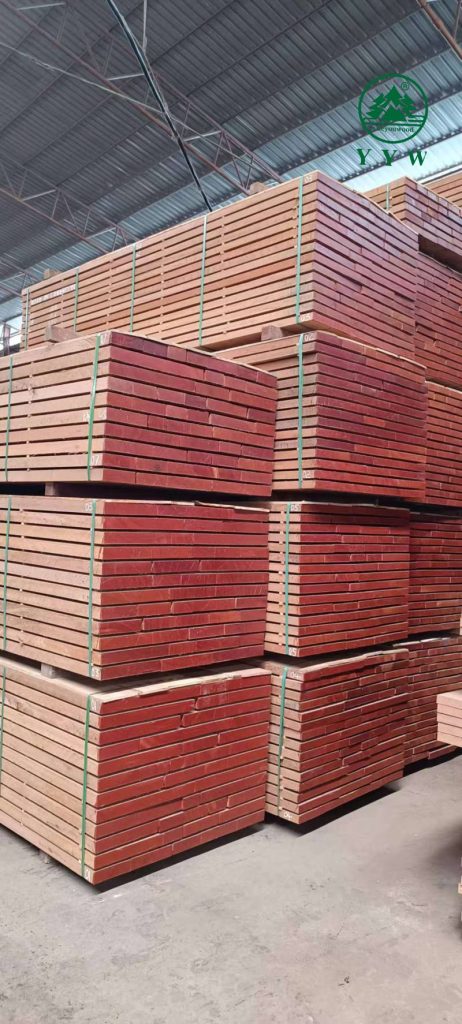
The durability of flooring is directly correlated to its density and hardness. Sapele exhibits a specific gravity of roughly 0.67 (at 12% Moisture Content), making it significantly denser than many domestic North American hardwoods.
Janka Hardness Rating: Sapele scores approximately 1,510 lbf (6,700 N) on the Janka hardness scale. By comparison, Red Oak sits at 1,290 lbf and Genuine Mahogany at roughly 900 lbf. This 17% increase over Red Oak translates to superior resistance against heels, pet claws, and furniture indentation, making Sapele an ideal candidate for high-traffic commercial foyers and upscale retail environments.
Structural Integrity and Strength
Beyond surface hardness, the wood’s structural strength ensures longevity under stress. Sapele boasts a Modulus of Rupture (MOR) of approximately 15,930 lbf/in² (109.9 MPa) and a Modulus of Elasticity (MOE) of 1,740,000 lbf/in² (12.00 GPa). These figures indicate a stiff, strong timber that resists bending and deformation under static loads.
Comparative Analysis of Sapele vs Genuine Mahogany
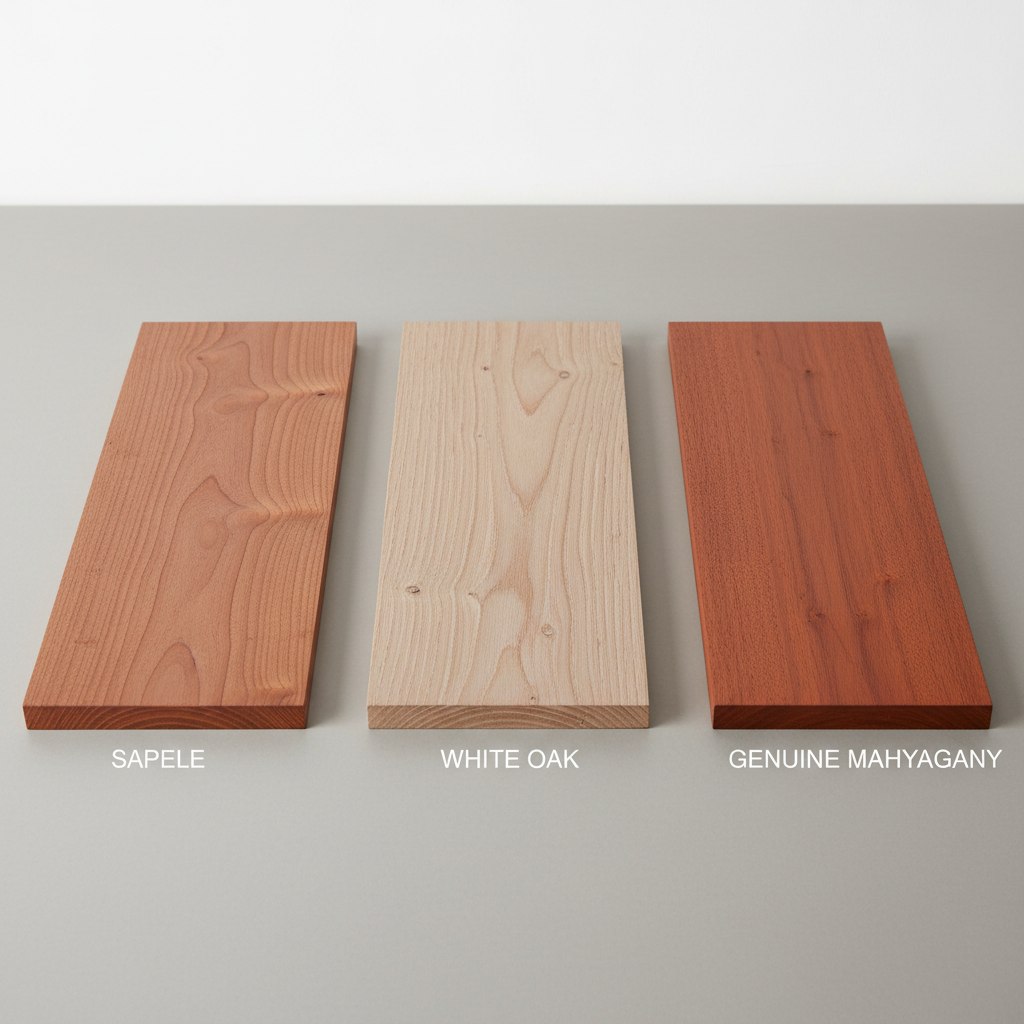
Architects frequently weigh Sapele against Genuine Mahogany (Swietenia macrophylla) or domestic White Oak. While Genuine Mahogany is revered for stability, Sapele offers a harder wearing surface at a more competitive price point.
| Property | African Sapele | Genuine Mahogany | White Oak |
|---|---|---|---|
| Janka Hardness | 1,510 lbf | 900 lbf | 1,360 lbf |
| Specific Gravity (12% MC) | 0.67 | 0.54 | 0.68 |
| Modulus of Rupture | 15,930 lbf/in² | 11,710 lbf/in² | 15,200 lbf/in² |
| Tangential Shrinkage | 7.2% | 4.1% | 10.5% |
| Radial Shrinkage | 4.6% | 3.0% | 5.6% |
| Cost Index | Moderate | High/Premium | Moderate |
Analysis: While Genuine Mahogany offers superior dimensional stability (lower shrinkage rates), its softness makes it less viable for flooring in heavy-traffic zones. Sapele bridges the gap, offering the rich aesthetic of mahogany with the mechanical resilience of oak.
Handling Interlocked Grain and Machining
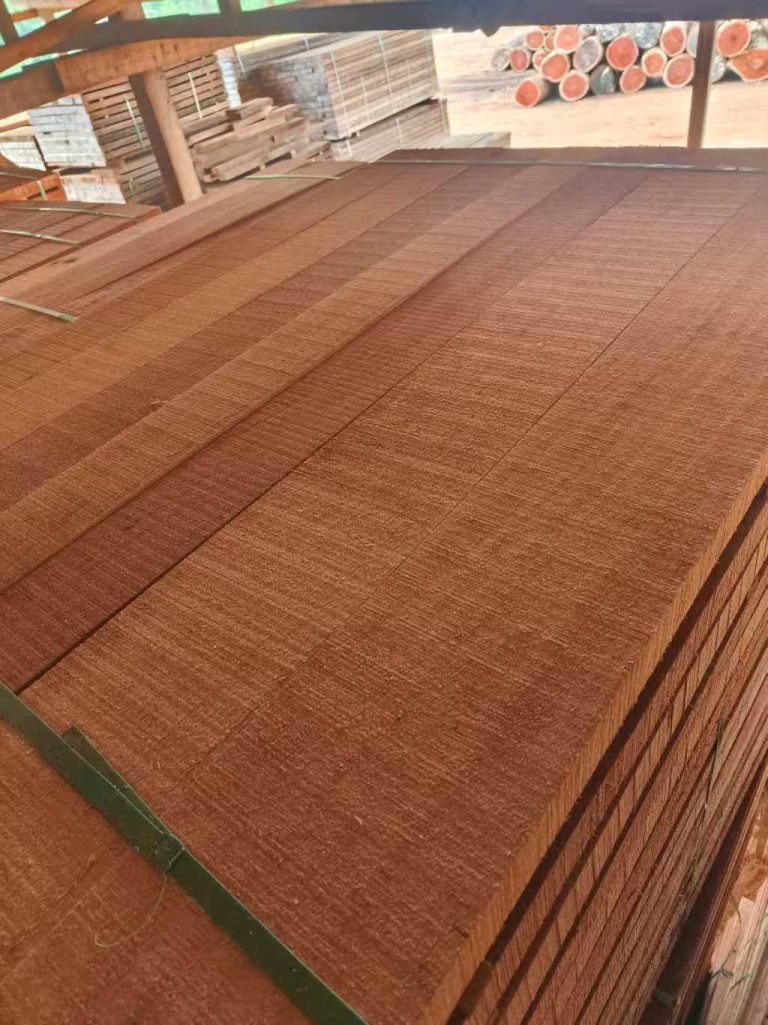
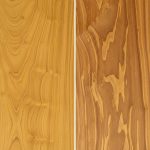
The defining visual characteristic of Sapele is its interlocking grain, which produces the highly prized “ribbon stripe” figure when quartersawn. However, this feature presents specific challenges during the milling and finishing phases.
Prevention of Tear-Out
Because the grain direction alternates, planing Sapele can result in significant tear-out if standard cutting angles are used. Professional millworks should utilize a cutting angle of 15° to 20° rather than the standard 45°. Helical cutterheads are strongly recommended to reduce impact and produce a smoother surface finish.
Sanding and Finishing Protocols
Sapele reacts with iron, leading to blue-black discoloration if in contact with moisture and ferrous metal. Stainless steel fasteners are mandatory for installation. During sanding, the interlocked grain requires a finer grit progression to avoid cross-grain scratching. Sapele takes stains and oils exceptionally well, deepening to a dark reddish-brown known as “mahogany finish” without the need for heavy pigmentation.
Dimensional Stability and Acclimatization
Understanding the hygroscopic nature of Sapele is essential for preventing cupping or gapping post-installation. Sapele has a volumetric shrinkage of 12.8%, which is moderate.
The T/R Ratio (Tangential to Radial shrinkage) is approximately 1.4 to 1.6. A lower ratio generally indicates uniform shrinkage. While Sapele is more stable than White Oak (which has a ratio often exceeding 1.8), it is less stable than Genuine Mahogany. Contractors must ensure strict acclimatization on-site, maintaining relative humidity (RH) between 35% and 55%. Failure to control RH swings can lead to pronounced movement due to the wood’s density and interlocking fibers.
Sustainability and Procurement Compliance
For wholesalers, ethical sourcing is a primary concern. Sapele is widely available, but populations have decreased in certain West African regions. It is listed on the IUCN Red List as Vulnerable.
To ensure compliance and marketability to eco-conscious clients, wholesalers should prioritize FSC-certified (Forest Stewardship Council) Sapele. Unlike Genuine Mahogany, which is heavily restricted under CITES Appendix II, Sapele faces fewer international trade restrictions, ensuring a more reliable supply chain for large-scale renovation projects.
Applications Beyond Flooring
Due to its rot resistance (rated as moderately durable to durable regarding decay resistance), Sapele is versatile. It is frequently utilized in:
- Exterior Joinery: Window frames and doors, provided a UV-protective finish is applied to prevent graying.
- Marine Applications: Often used as a substitute for Mahogany in boat building for interior cabinetry and trim.
- Architectural Millwork: Veneers for paneling and high-end cabinetry where the ribbon stripe figure creates visual impact.
Frequently Asked Questions
Yes. With a Janka rating of 1,510 lbf, Sapele is approximately 17% harder than Red Oak and 11% harder than White Oak, offering superior dent resistance.