Okoume wood (Aucoumea klaineana) is a lightweight African tropical hardwood renowned for its exceptional rotary peeling qualities. Averaging a density of 430 kg/m³, it is the premier core material for marine-grade plywood (BS 1088) and a highly resonant tonewood for acoustic guitars, offering unmatched strength-to-weight ratios for industrial manufacturing and millwork.
Table of Contents
- What is Okoume Wood? The “King of African Timber” Explained
- Okoume Wood Properties and Technical Specifications
- Okoume Wood Processing Forms: From Forest to Factory
- What is Okoume Wood Used For? Top Industrial Applications
- Okoume vs. Other Hardwoods: Making the Right Choice
- Sourcing Sustainable Okoume: FSC Certification and Supply Chain
- People Also Ask (PAA) – Technical FAQ
What is Okoume Wood? The “King of African Timber” Explained
Walking through the dense equatorial forests of the Congo Basin, Aucoumea klaineana stands out. Commercially known as Okoume (or Gaboon), this species dictates a massive portion of the West African timber export economy. Decades of trading this species have cemented its reputation not as a structural behemoth, but as the absolute pinnacle of utility and peeling efficiency.
Is Okoume a Hardwood? Understanding Botanical Classifications
A frequent point of confusion among new buyers is the classification of Okoume. Yes, Okoume wood is botanically a true hardwood (angiosperm), as it reproduces using enclosed seeds and broad leaves. However, its physical hardness tells a different story. In the timber trade, “hardwood” does not necessarily dictate density. Okoume is physically softer than many commercial softwoods (gymnosperms) like Douglas Fir. This unique combination—the smooth, uniform cellular structure of a hardwood paired with the low density of a softwood—is exactly what makes it the holy grail for veneer slicing and rotary peeling.
Origins of Aucoumea klaineana: Gabon, Congo, and Equatorial Guinea
The natural distribution of Okoume is highly restricted, creating a concentrated supply chain. It is almost exclusively found in Gabon, the Republic of the Congo, and Equatorial Guinea. Gabon alone holds the vast majority of the world’s Okoume forests. From a sourcing perspective, the 2010 log export ban in Gabon fundamentally shifted the global market. Raw Okoume logs from Gabon are no longer legally exported; instead, the government mandates local processing, meaning buyers must now source sawn timber, rotary-cut veneer, or finished plywood directly from the Special Economic Zone (GSEZ) in Nkok, or look to neighboring Congo for raw logs under strict quotas.
Okoume Wood Properties and Technical Specifications
Factory floor managers and kiln operators demand precise data, not generic descriptions. The machining behavior of Okoume is governed entirely by its physical metrics.
Okoume Wood Density and Specific Gravity
At a standard moisture content (MC) of 12%, Okoume exhibits an average density of 430 kg/m³ (27 lbs/ft³). Its specific gravity ranges between 0.35 and 0.45 depending on the exact growth region and soil conditions. This exceptionally low density translates to significantly reduced shipping weights for bulk buyers. When calculating logistics for shipping containers out of Libreville or Pointe-Noire, a standard 40-foot container can hold a considerably higher volume of Okoume sawn timber compared to heavier African species like Padauk or Tali before hitting road weight limits.
Okoume Hardness: Is it Strong Enough? (Janka Rating)
With a Janka hardness rating of merely 400 lbf (1,790 N), Okoume is extremely soft. To put this in perspective, it is roughly as soft as Basswood. It dents easily under direct impact. Therefore, it is never recommended for flooring or heavy load-bearing structural beams. Its strength lies entirely in its strength-to-weight ratio when cross-laminated into plywood, where the alternating grain directions compensate for the natural softness of the individual wood fibers.
Color, Grain, and Durability Profile
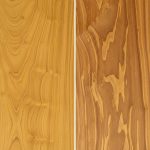
Freshly cut Okoume heartwood presents a pale pinkish-brown hue that naturally darkens to a lustrous, deeper reddish-brown with prolonged UV exposure. The sapwood is distinctly paler, usually grayish-white, and is typically trimmed during the FAS grading process. The grain is generally straight to slightly interlocked, yielding a highly uniform texture with a good natural luster.
Regarding natural durability, Okoume is rated as non-durable to perishable. It offers zero natural resistance to marine borers or termite attacks. If utilized in exterior applications, it mandates chemical treatment or must be fully encapsulated in epoxy (a standard practice in the boat-building industry).
Okoume Wood Processing Forms: From Forest to Factory
The commercial lifecycle of Okoume dictates how it is bought and sold on the international B2B market.
Okoume Logs: Sourcing and Export Regulations
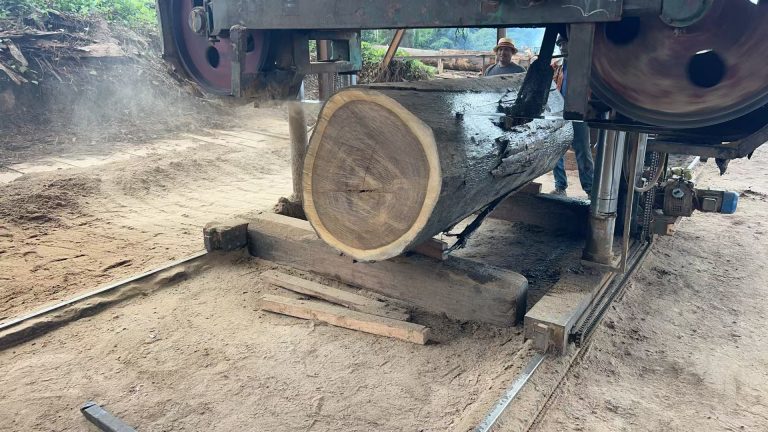
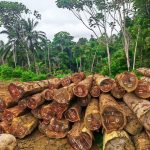
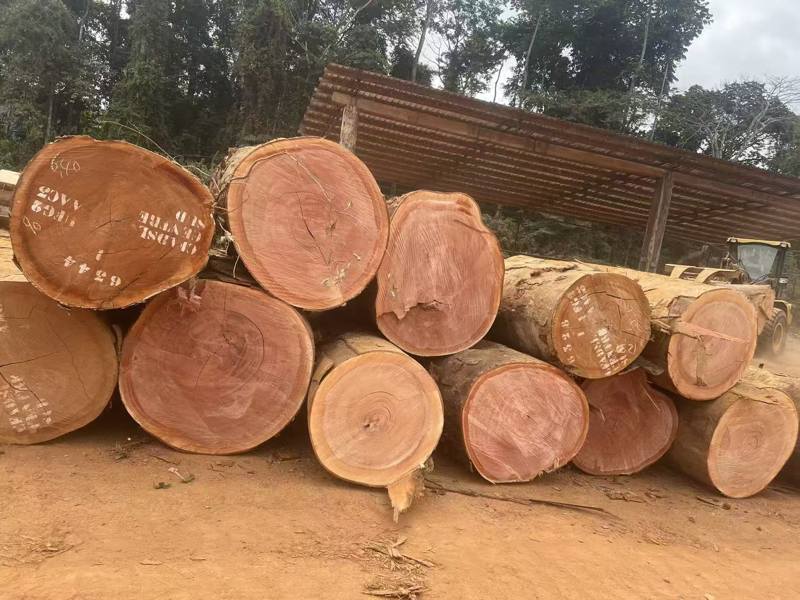
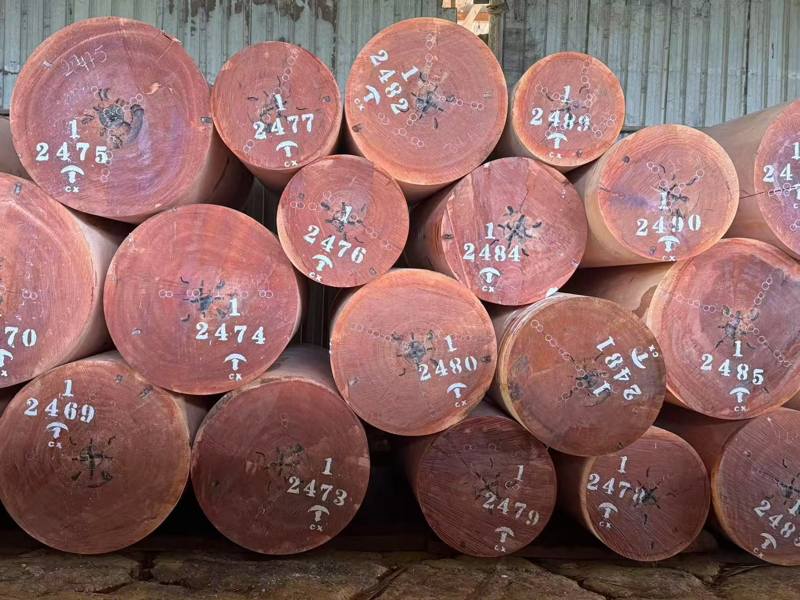
For factories equipped with their own peeling lathes, sourcing Okoume logs remains the primary objective. Due to Gabon’s export restrictions, the Republic of Congo (Brazzaville) and Equatorial Guinea are the primary origins for round logs. Okoume logs are graded under ATIBT (Association Technique Internationale des Bois Tropicaux) rules, specifically focusing on the FAQ (Fair Average Quality) and LM (Loyal and Merchantable) grades. We look for logs with minimal heart rot and a perfectly cylindrical shape to maximize peeling yield.
Okoume Sawn Timber (FAS Grade and Custom Cut)
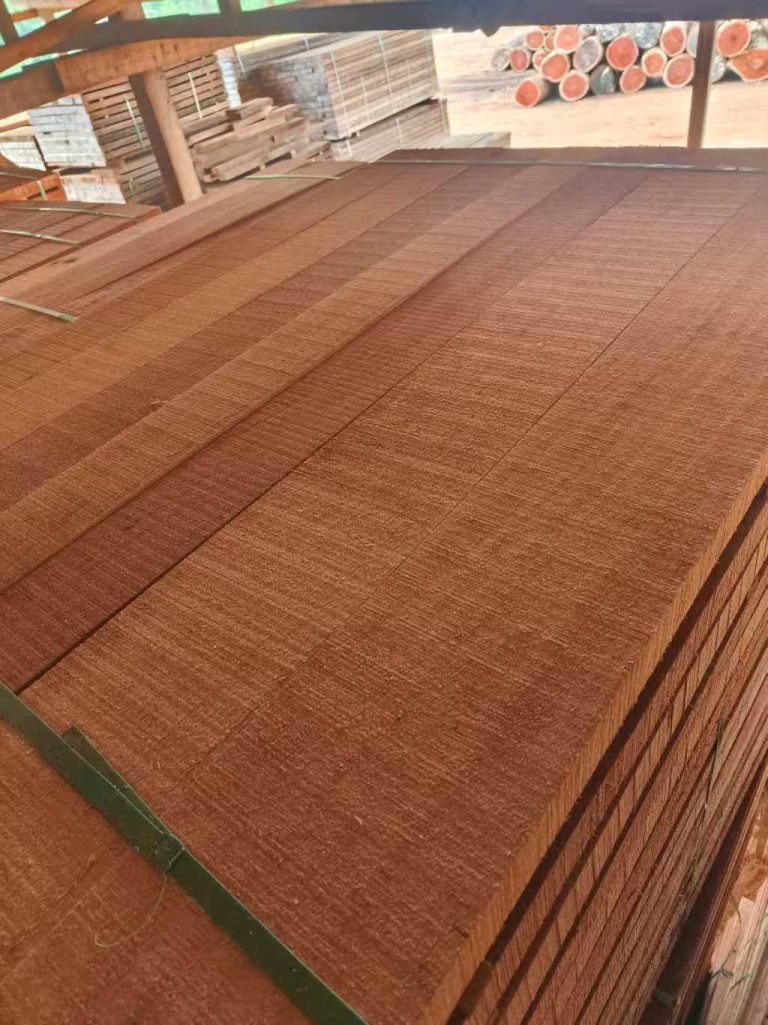
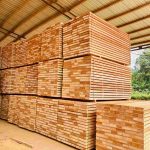
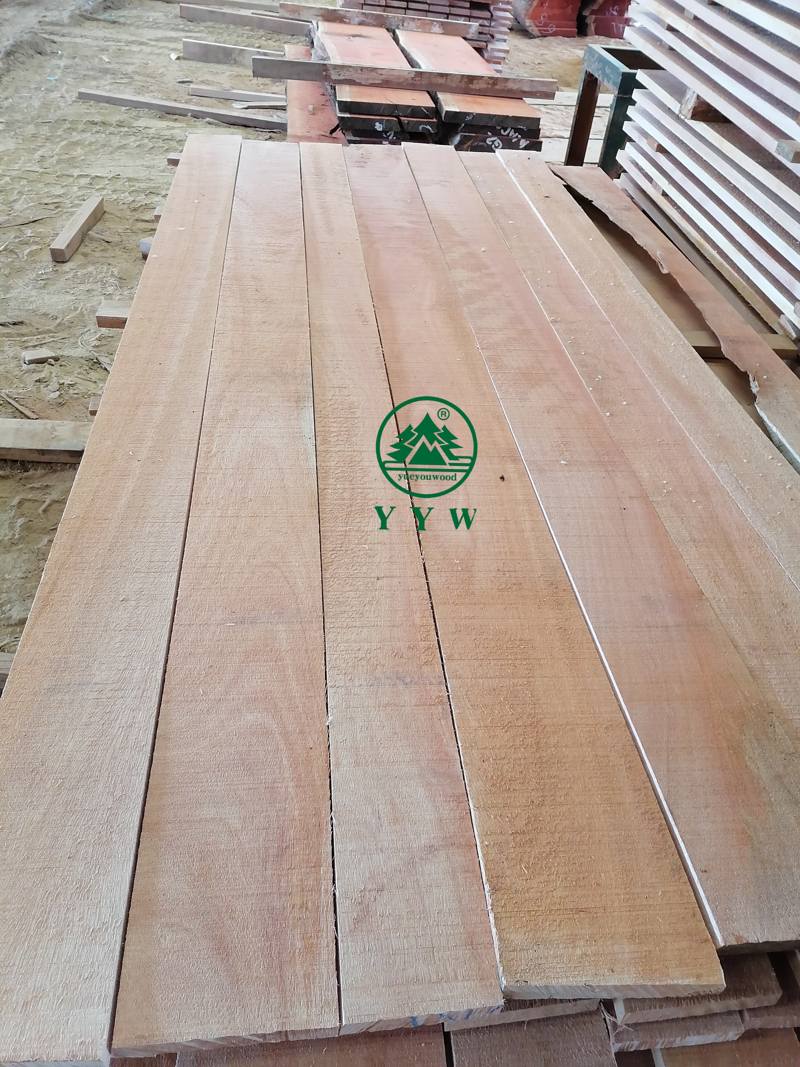
Okoume timber is typically kiln-dried (KD) to a target MC of 10-12% before export. Because of its high silica content (averaging 0.12% to 0.16%), it has a moderate blunting effect on cutting tools. Sawmills must equip tungsten-carbide-tipped (TCT) blades to maintain clean cuts. The standard export grade is FAS (First and Seconds), ensuring wide, clear boards free of major knots and sapwood, ideal for architectural millwork.
Don’t know the grades of Okoume? Check Okoume Grading Guide
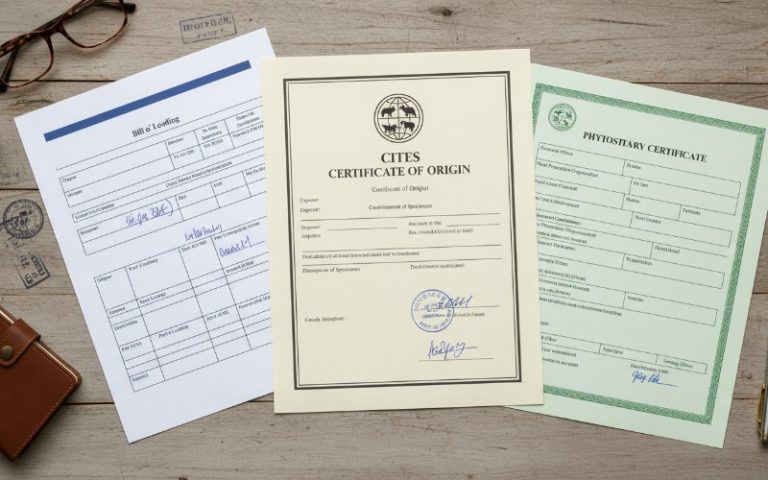
If you want to import Okoume to EU & USA, check this essential documentation checklist
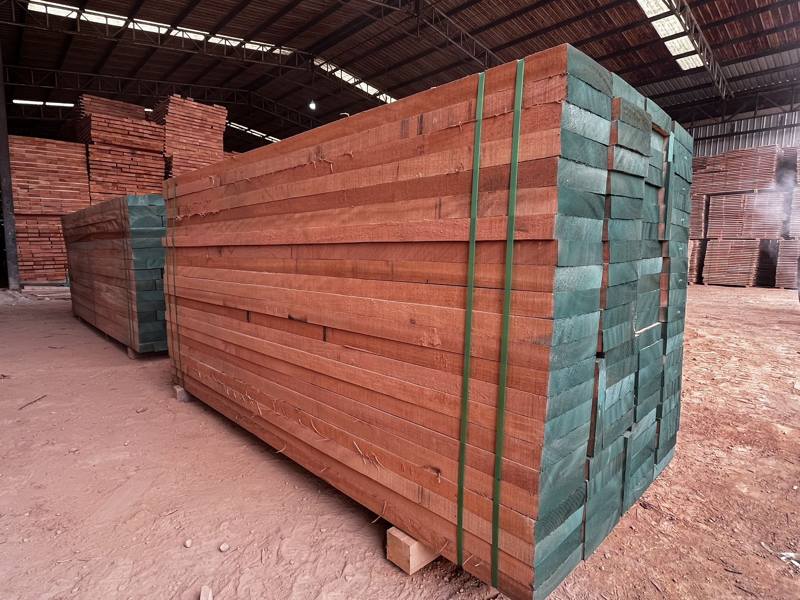
💡 Planning your procurement for the next quarter? Explore our live inventory of KD FAS Okoume Sawn Timber and secure factory-direct pricing from our African mills.
What is Okoume Veneer? (Rotary Cut vs. Sliced)
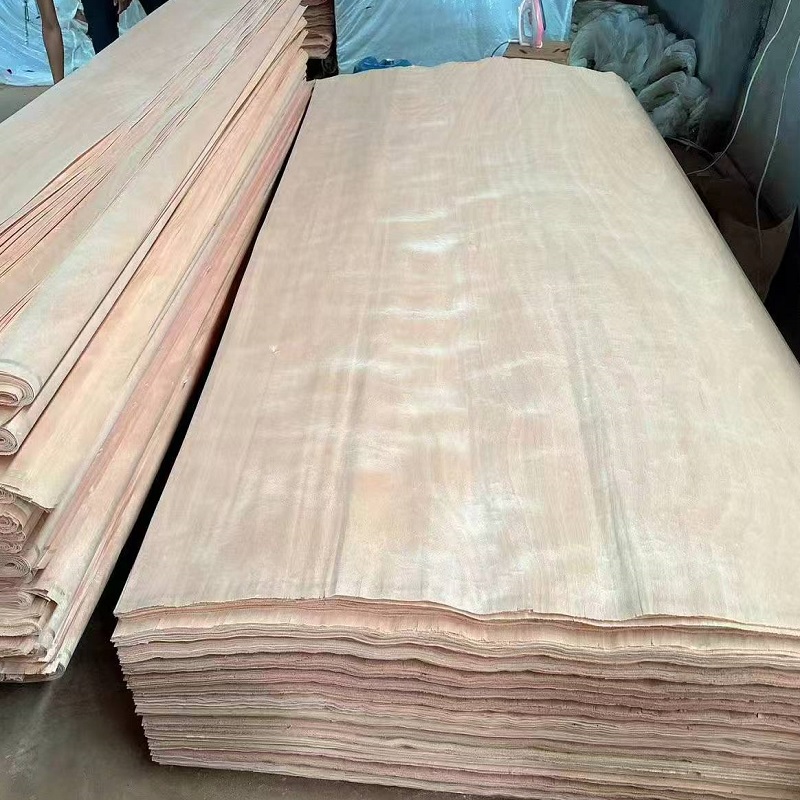
The absolute dominant form of Okoume processing is rotary-cut veneer. The log is soaked in hot water vats to soften the fibers, then mounted on a lathe and spun against a massive blade, unspooling the wood like paper. Okoume’s uniform density allows for continuous peeling of ultra-thin sheets (down to 0.3mm) without tearing. Sliced veneer, while less common, is occasionally produced for decorative paneling to showcase its subtle ribbon-stripe figure when quarter-sawn.
Take a detailed look at our Okoume wood veneer.
What is Okoume Plywood? Marine-Grade vs. Standard
When these veneers are glued together using WBP (Water Boiled Proof) phenolic resins, the result is Okoume plywood. Standard commercial Okoume plywood is utilized for interior furniture. However, the premium tier is Marine-Grade Okoume Plywood. This requires zero core voids and strict adherence to boiling water tests, making it a highly lucrative export product for specialized timber merchants.
What is Okoume Wood Used For? Top Industrial Applications
Understanding the end-use applications is vital for importers matching material to manufacturing needs.
Okoume Plywood in Boat Building and Marine Applications
Okoume is the undisputed king of the boat-building industry. Shipwrights prefer it because a sheet of Okoume marine plywood is up to 25% lighter than an equivalent sheet of Meranti plywood. In racing yachts, kayaks, and high-performance skiffs, weight reduction is critical. When completely sealed with marine epoxy and fiberglass cloth, the lack of natural rot resistance is negated, leaving only its incredible dimensional stability and light weight.
It is also preferred for RV Okoume plywood interiors.
Okoume Wood Furniture and Millwork
In the European and Middle Eastern markets, Okoume is heavily utilized as a core material for high-end furniture. It accepts stains and finishes exceptionally well, often serving as an affordable substrate that is subsequently covered with expensive, exotic decorative veneers like Ebony or Rosewood. Its workability allows for flawless CNC routing and edge profiling.
Is Okoume Wood Good for Guitars? (Acoustic Tonewood Properties)
Over the last decade, Okoume has surged in popularity among luthiers and major guitar manufacturers (including brands like Ibanez). Yes, Okoume is an excellent tonewood. It offers a warm, resonant acoustic profile heavily reminiscent of traditional Mahogany, but at a fraction of the weight. Its lightweight nature makes solid-body electric guitars incredibly comfortable for musicians to play during long stage performances, while its uniform grain allows for stunning high-gloss finishes.
Okoume vs. Other Hardwoods: Making the Right Choice
Buyers frequently ask us to run comparative analyses before they commit to a large-scale letter of credit (LC). Here is the technical breakdown.
| Species Name | Average Density | Best Suited For | Price Index | [YYW Timber] Expert Advice |
|---|---|---|---|---|
| Okoume (Aucoumea klaineana) | 430 kg/m³ | Marine plywood, Guitar bodies, Veneer | $$ | Unbeatable for lightweight applications. Highly recommended if you are manufacturing epoxy-sealed boats or need the best rotary peeling yield. |
| African Mahogany (Khaya spp.) | 530 kg/m³ | High-end furniture, Exterior joinery | $$$$ | Significantly harder and naturally durable. Choose Khaya for visible, clear-finished luxury furniture, but avoid it for hidden plywood cores due to cost. |
| Sapele (Entandrophragma cylindricum) | 670 kg/m³ | Flooring, Windows, Decorative Veneer | $$$ | Very heavy and strong. The interlocking grain creates a beautiful ribbon stripe. Sapele is an exterior-grade wood, whereas Okoume is strictly for interior/sealed use. |
African Okoume vs. Mahogany: A Cost-Effective Alternative?
Visually, Okoume is often marketed as a “Mahogany substitute.” While the reddish-brown tint is similar, structurally, they are leagues apart. African Mahogany (Khaya spp.) is much denser, harder, and naturally durable. If your factory is manufacturing carved doors or structural luxury furniture, Mahogany is required. If you are manufacturing painted cabinets, lightweight panels, or guitar bodies where surface hardness is protected by poly-coatings, Okoume is the ultimate cost-effective alternative.
Okoume vs. Sapele: Which Veneer Should You Choose?
Sapele is dense, heavy, and boasts a striking, highly pronounced ribbon-stripe figure. Sapele veneer is primarily used for its decorative aesthetics on the outside of luxury items. Okoume veneer is functional; it is used on the inside as a structural core or on the outside of utilitarian plywood. Sapele demands slower machining speeds due to its interlocking grain, which can cause tear-out, whereas Okoume machines effortlessly.
Get more knowledge of the difference between Okoume and other species:
Sourcing Sustainable Okoume: FSC Certification and Supply Chain
The modern timber trade is governed by strict environmental compliance. Major buyers in the EU and USA face severe penalties under the EUTR (European Timber Regulation) and the US Lacey Act for importing illegal timber.
When procuring Okoume, demanding FSC (Forest Stewardship Council) or PEFC (Programme for the Endorsement of Forest Certification) certified timber is no longer optional for high-end markets. At YYW Timber, we actively audit our West African concessions. With Gabon’s upcoming forestry regulations enforcing 100% downstream tracking by 2026, partnering with a supplier who integrates transparent chain-of-custody (CoC) documentation ensures your factory lines never stop due to customs seizures.
Okoume Timber Stock Update: Warehouse Inventory Available
From Forest to Warehouse: How Okoume Timber Moves Through a Controlled Supply Chain
Ready to optimize your factory’s timber supply chain?
Get my direct wholesale pricing and technical specification guide. Book my 1-on-1 procurement review, and let’s calculate your precise landing costs for Okoume sawn timber and veneer.