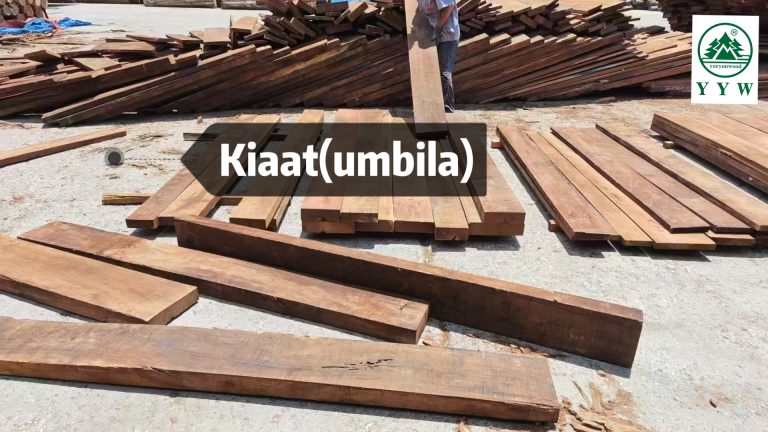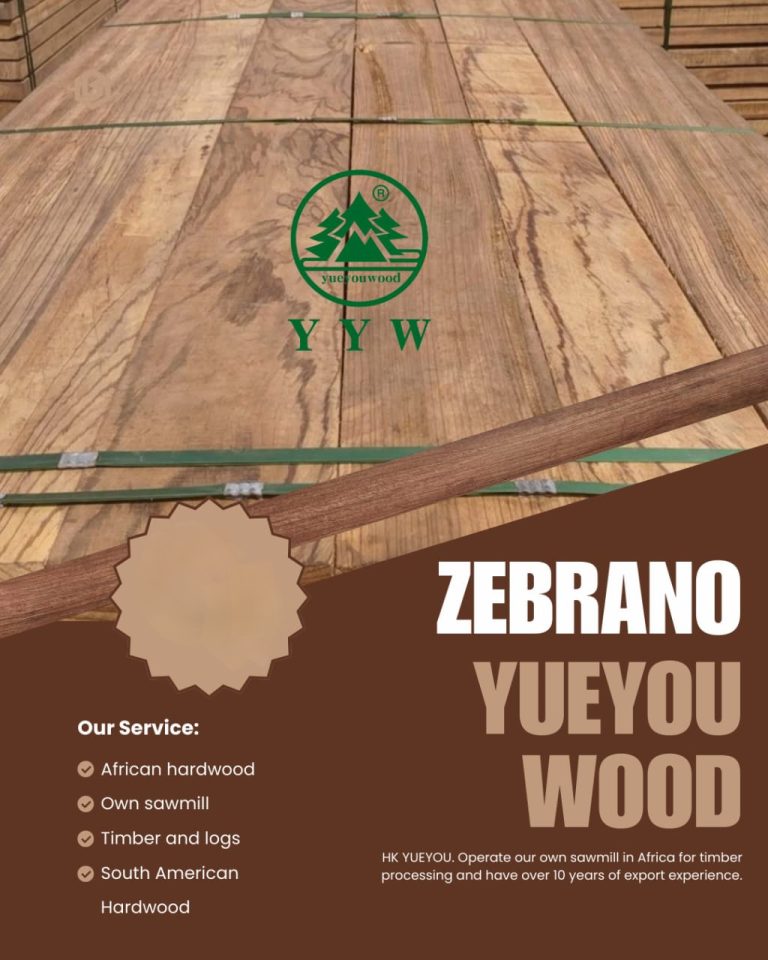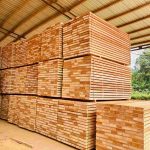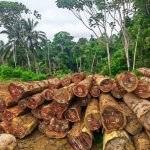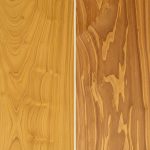
Kosipo wood (Entandrophragma candollei) is a dense, purple-brown African hardwood offering superior wear resistance over Sapele and Utile. Utile provides superior dimensional stability for exterior joinery, while Sapele delivers distinctive ribbon striping for architectural veneers. Selecting the optimal species requires balancing silica content, tear-out risks, and kiln-drying dynamics across your production line.
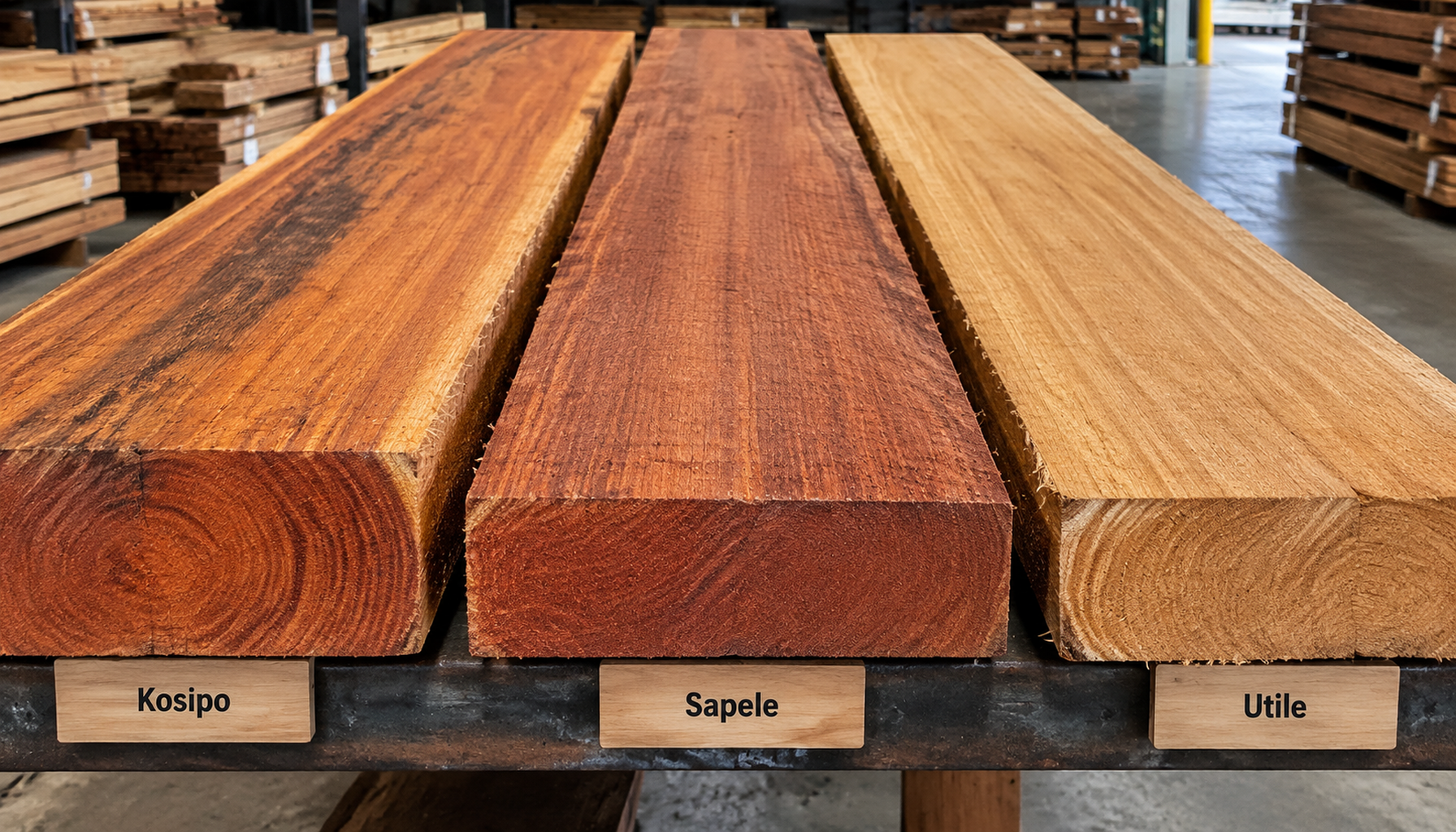
How Do You Visually Differentiate Kossipo, Sapele, and Utile in Raw Lumber Form?
Visual identification of unplaned, rough-sawn lumber from the Entandrophragma genus demands close macroscopic inspection of end-grain parenchyma patterns and heartwood color. Factory timber inspectors frequently misidentify rough-sawn cants because surface oxidation obscures fresh wood tones. According to research published by the Wood Database, anatomical differences in axial parenchyma and pore distribution provide definitive identification benchmarks before machining begins.
Kosipo wood displays a distinct dark reddish-brown hue, frequently shifting toward deep purplish-brown or violet overtones upon atmospheric exposure. The growth rings in Kosipo feature continuous, wide bands of marginal axial parenchyma easily visible to the naked eye. In contrast to Sapele, fresh Kosipo lumber lacks any detectable cedar-like fragrance. The grain structure remains heavily interlocked, exhibiting a coarser surface texture than related West and Central African timber species.
Sapele (Entandrophragma cylindricum) exhibits a lighter, warm copper to golden-brown heartwood that darkens uniformly upon oxidation. Freshly cut or planed Sapele releases a distinct, pleasant aromatic scent reminiscent of Spanish cedar. End-grain analysis reveals narrow, wavy bands of axial parenchyma spaced tightly throughout annual growth rings. Quartersawn rough stock demonstrates tightly spaced, uniform interlocked grain bands measuring 5 mm to 15 mm across.
Utile (Entandrophragma utile), commercially termed Sipo, occupies an intermediate visual position with distinctive diagnostic traits. Utile heartwood features a muted, uniform reddish-brown cast without the distinct purple cast of Kosipo wood. End-grain cross-sections demonstrate broken, tangential parenchyma lines in reticulate or scalariform arrangements under a 10x hand lens. Utile lumber lacks scent and exhibits broader, more irregular ribbon grain than quartersawn Sapele lumber.
- Kosipo (E. candollei): Violet-brown tone, coarse texture, wide marginal parenchyma bands, completely scentless.
- Sapele (E. cylindricum): Copper-red tone, fine texture, narrow ribbon grain, distinct aromatic cedar scent.
- Utile (E. utile): Medium reddish-brown, moderate ribboning, reticulate parenchyma network, completely scentless.
Head-to-Head Technical Matrix: Janka Hardness, Density, and Movement in Service
Industrial wood engineers must evaluate physical mechanics when selecting heavy mahogany alternatives for high-performance structural applications. Kosipo wood features the highest raw mechanical density among commercial Entandrophragma species, producing superior surface impact resistance. The comprehensive mechanical properties compiled by the USDA Forest Products Laboratory highlight significant performance variations across density, stiffness, and tangential-to-radial shrinkage ratios.
| Technical Parameter | Kosipo (E. candollei) | Sapele (E. cylindricum) | Utile (E. utile) |
|---|---|---|---|
| Air-Dry Density (12% MC) | 710 kg/m³ (44.3 lbs/ft³) | 670 kg/m³ (41.8 lbs/ft³) | 635 kg/m³ (39.6 lbs/ft³) |
| Janka Side Hardness | 5,340 N (1,200 lbf) | 6,270 N (1,410 lbf) | 5,250 N (1,180 lbf) |
| Modulus of Rupture (MOR) | 112 MPa (16,240 psi) | 114 MPa (16,530 psi) | 99 MPa (14,350 psi) |
| Modulus of Elasticity (MOE) | 12.1 GPa (1,755,000 psi) | 12.0 GPa (1,740,000 psi) | 10.6 GPa (1,537,000 psi) |
| Radial Shrinkage (Green to 0% MC) | 5.1% | 4.6% | 3.7% |
| Tangential Shrinkage (Green to 0% MC) | 8.4% | 7.4% | 6.0% |
| T/R Shrinkage Ratio | 1.65 | 1.61 | 1.62 |
| Volumetric Shrinkage | 15.2% | 14.0% | 11.6% |
| Movement in Service Classification | Medium to High | Medium | Small |
Kosipo provides substantial load-bearing capacity, matching Sapele across bending strength parameters while exhibiting a higher dry density of 710 kg/m³. Technical documentation from CIRAD Forestry Research indicates that Kosipo experiences elevated volumetric shrinkage of 15.2%. This elevated volumetric reduction requires controlled conditioning within production facilities before primary manufacturing processes occur.
Utile maintains the lowest volumetric shrinkage at 11.6%, alongside a minimal tangential shrinkage metric of 6.0%. Consequently, Utile delivers superior dimensional stability across installations exposed to fluctuating indoor or outdoor relative humidity. Sapele delivers the highest Janka hardness value at 6,270 N, making it exceptionally resilient against mechanical surface indentation in commercial interior installations.
Which Species Performs Better in Precision Exterior Windows and Doors?
Precision fenestration components require low moisture-induced movement to prevent frame binding and acoustic seal degradation across seasonal transitions. Window stiles and exterior door rails must maintain absolute dimensional alignment when exposed to direct atmospheric weathering. Testing frameworks established by BRE Global evaluate both inherent biological durability and tangential movement coefficients under cyclic environmental conditions.
Utile is the premier choice for precision exterior fenestration systems among African hardwood timbers. Its radial shrinkage of 3.7% and tangential shrinkage of 6.0% minimize cross-sectional dimensional distortion. In high-performance architectural fenestration, laminated Utile scantlings resist warping, cupping, and twisting significantly better than Sapele or Kosipo lumber components.
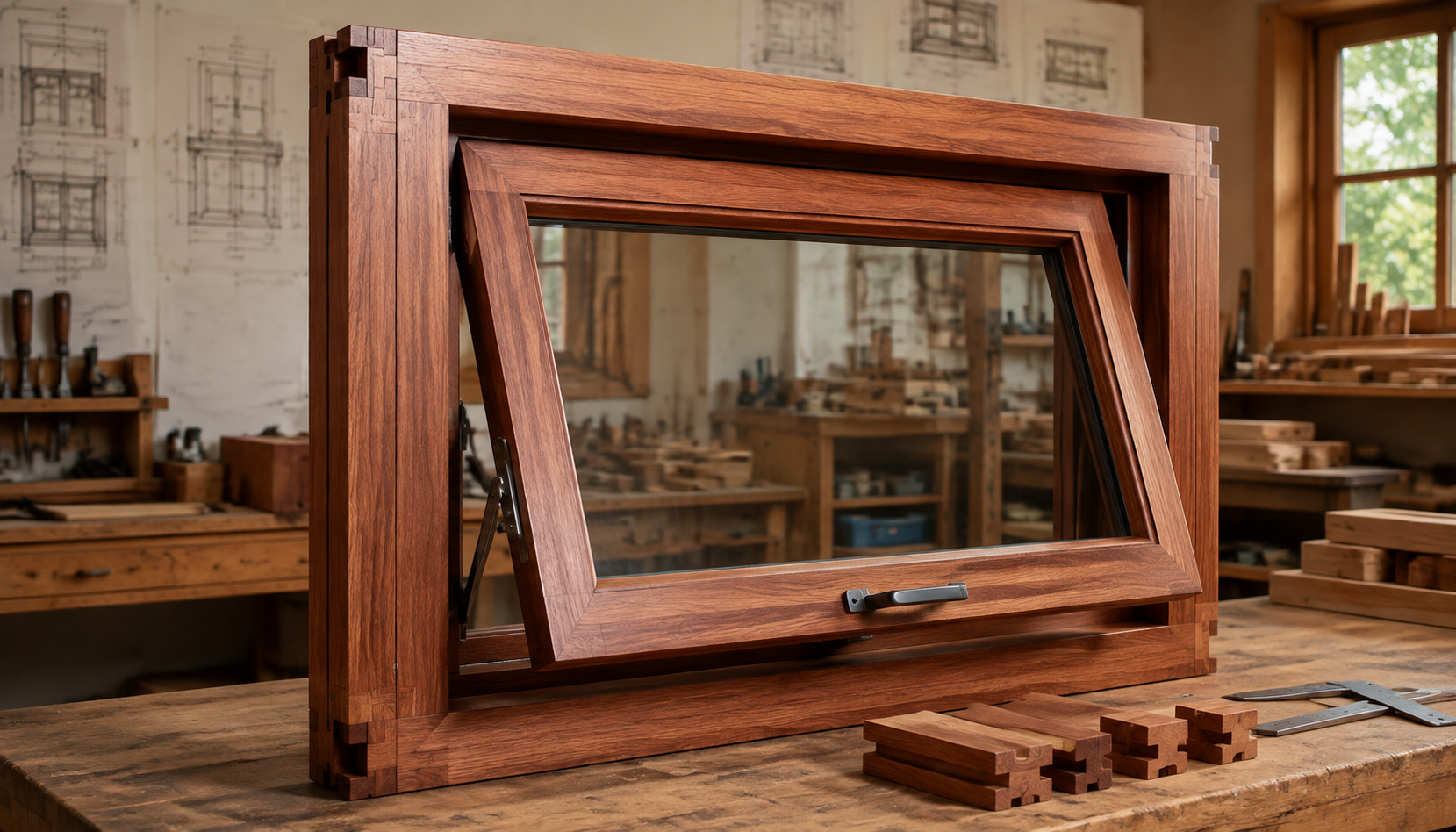
Kosipo wood exhibits higher moisture absorption rates and total volumetric movement under exterior environmental exposure. Without robust hydrophobic surface coatings, solid Kosipo stiles expand tangentially across seasonal cycles, risking operational clearance failures. Kosipo provides excellent natural durability rated Class 2 (durable) under ISO 21887 fungal decay guidelines, but its moisture responsiveness requires careful joint engineering.
Sapele serves as an industry standard for external doors, though manufacturing facilities must utilize quartersawn lumber stock exclusively. Riftsawn or flatsawn Sapele components tend to twist under direct ultraviolet exposure due to high interlocked grain stress. Engineered three-ply laminated profiles effectively mitigate this movement, making Sapele a commercially viable window material when engineered properly.
Workability and Tear-Out Risks: Planing Interlocked Grain in Sapele vs Kossipo
Interlocked grain structures present severe machining challenges during high-speed secondary wood processing operations. As rotational planer knives engage alternating fiber growth angles, severe subsurface grain tear-out can quickly occur. Empirical processing studies from the ATIBT Technical Association confirm that cutterhead geometry and cutter tooling metallurgy dictate surface defect frequencies across African hardwoods.
Sapele possesses tight, regular ribbon striping where directional fiber alignment changes abruptly every 10 mm to 15 mm across radial surfaces. Standard industrial moulder cutting angles of 30 degrees lift these opposing fiber bundles, producing micro-tearing along quartersawn profiles. Moulder tooling engineers must decrease the primary cutting rake angle to 15 or 20 degrees to shear grain bundles cleanly without subsurface fractures.
Kosipo wood introduces distinct machining challenges stemming from mineral distribution within its cellular parenchyma structures. Technical wood assessments confirm that Kosipo contains significant crystalline silica deposits within its ray and axial parenchyma cells. These silica inclusions cause rapid abrasive tool wear, dulling standard high-speed steel (HSS) planer knives within 200 linear meters of continuous throughput.
Processing Kosipo lumber profitably requires specialized cutting tooling upgrades throughout your high-volume processing lines:
- Tool Metallurgy: Use sub-micron grade tungsten carbide tooling (TCT) or polycrystalline diamond (PCD) inserts to resist silica abrasion.
- Cutting Angles: Maintain a 15-degree hook angle on four-sided planning heads to mitigate interlocked grain lift.
- Feed Speed Control: Reduce feed rates to maintain 18 to 22 knife marks per inch, minimizing deep fiber tear-out.
- Sanding Grit Progression: Implement 80-grit cross-belt sanding before wide-belt calibration to level unevenly sheared interlocked cells.
Utile features more forgiving machining characteristics due to its lower density and broad, gentle ribbon transitions. It lacks abrasive silica deposits, allowing prolonged production runs using conventional micro-grain tungsten carbide cutters. Factory yield rates on surfaced Utile lumber typically exceed Kosipo production yields by 8% to 12% due to reduced machining defects.
Price-to-Performance Ratio and Forest Sourcing Availability Across Central Africa
Procurement economics across Central Africa depend heavily on forest concession inventories, selective harvesting quotas, and regional transport infrastructure. The International Tropical Timber Organization (ITTO) tracks market price trends and export volumes from major Central African timber ports. Examining export prices reveals substantial material cost differentials among these three commercial timber species.
Sapele constitutes the highest commercial harvesting volume within the Congo Basin, harvested sustainably across Cameroon, the Republic of Congo, and Gabon. Because supply chains are mature and logging volumes are consistent, Sapele FAS rough-sawn lumber maintains predictable pricing metrics. Sapele establishes the benchmark export market pricing for non-coniferous Central African joinery hardwoods.
Kosipo wood offers notable raw material purchasing value for industrial manufacturers equipped with proper carbide or diamond tooling. Kosipo rough-sawn lumber trades at an 8% to 15% discount against standard Sapele export contracts. The species occurs in lower forest densities per hectare, but substantial log diameters yielding 90 cm to 140 cm clear cants provide excellent commercial board conversion.
Utile commands a pricing premium ranging from 12% to 25% above standard Sapele specifications on global timber markets. Forest concession quotas for Entandrophragma utile remain strictly regulated by national forestry authorities to maintain sustainable yields. The species is highly sought after by luxury superyacht builders and European fenestration manufacturers, keeping inventory levels tight throughout the export season.
Both Sapele and Kosipo lumber shipments from reputable Central African timber concessions meet strict international chain-of-custody compliance. Importers must secure certified paperwork verifying that shipments comply with the EU Deforestation Regulation (EUDR) and national extraction guidelines. Reliable suppliers provide complete legal traceability back to individual forestry management units.
Expert Selection Matrix: Matching the Right African Hardwood to Your Manufacturing Line
Selecting the ideal African timber species requires aligning your factory tooling capabilities, drying capacity, and end-product specifications. Deploying the wrong timber can quickly cause severe kiln defects, extensive cutter wear, or dimensional failure in finished installations. Factory technical directors should utilize this operational selection matrix to optimize material performance and product yields.
| Primary Manufacturing Application | First Choice Species | Alternative Option | Operational Rationale & Tooling Consideration |
|---|---|---|---|
| Exterior Window & Door Systems | Utile (E. utile) | Sapele (Quartersawn) | Utile offers low shrinkage (11.6% volumetric) and stable profile geometry; use laminated profiles. |
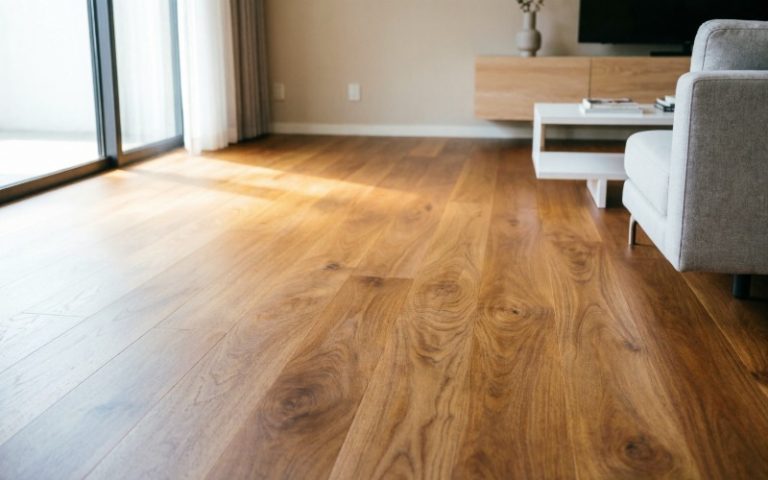
| High-Traffic Hardwood Flooring | Kosipo (E. candollei) | Sapele (E. cylindricum) | Kosipo provides 710 kg/m³ density and high indentation resistance; requires PCD tooling. |
| Architectural Wall Paneling & Veneers | Sapele (E. cylindricum) | Utile (E. utile) | Sapele yields dramatic, tight ribbon-stripe figure on quartered flitches for premium architectural matching. |
| High-End Cabinetry & Casegoods | Utile (E. utile) | Sapele (E. cylindricum) | Utile finishes evenly without severe grain tear-out; accepts stains uniformly without blotching. |
| Heavy Marine Construction & Decking | Kosipo (E. candollei) | Utile (E. utile) | Kosipo delivers Class 2 natural durability with strong abrasion resistance against marine foot traffic. |
| Staircase Strings, Risers & Treads | Kosipo (E. candollei) | Sapele (E. cylindricum) | High density resists point-load structural wear; pre-drill screw fixings to avoid splitting. |
Kiln-drying operations require specialized attention when scheduling these African timber species. Kosipo wood features high green moisture content combined with dense, thick cell walls that resist rapid capillary moisture migration. Operators must utilize mild drying schedules such as USDA Schedule T2-D4 to avoid interior honeycombing and cellular collapse. In contrast, Utile dries easily with minimal distortion, while Sapele demands steady final conditioning to eliminate internal casehardening stresses.
Frequently Asked Questions About Kosipo Wood and Related Species
Is kosipo wood classified as a true mahogany alternative?
Yes, Kosipo belongs to the Meliaceae family, which contains genuine American mahogany (Swietenia macrophylla). While technically belonging to the Entandrophragma genus, Kosipo is classified commercially as a heavy mahogany alternative. It delivers greater density, higher hardness, and darker coloration than traditional mahogany varieties.
Why does kosipo wood dull machine tooling faster than sapele?
Kosipo wood contains microscopic crystalline silica inclusions embedded within its axial and ray parenchyma cells. These inorganic mineral crystals act as abrasive agents against sharp steel cutting edges. Machining Kosipo cleanly requires industrial tungsten carbide (TCT) or polycrystalline diamond (PCD) cutting tools.
Can kosipo wood replace utile in exterior window construction?
Kosipo is not an ideal direct substitute for Utile in precision solid window frames. Kosipo exhibits higher volumetric shrinkage (15.2% versus 11.6% for Utile), increasing the risk of sash movement and binding. Kosipo should only be utilized in exterior joinery when processed into multi-ply engineered scantlings.
What surface finishes work best on interlocked grain African hardwoods?
High-solids polyurethane coatings, penetrating natural oils, and hardwax finishes all adhere exceptionally well to these species. Because Kosipo and Sapele contain interlocked grain with porous vascular channels, apply an initial sanding sealer or pore filler before final clear finishing. Solvent wiping with acetone is recommended before gluing to eliminate any natural surface resins.
Optimize Your Timber Supply Chain with YYW Timber: As an established direct supplier of African hardwoods, YYW Timber delivers commercial ocean containers of FAS rough-sawn lumber, squared cants, and round logs directly from certified Central African concessions. Contact our technical timber trading desk today to request species grading specifications, volume availability, and competitive CIF quotations tailored to your manufacturing requirements.