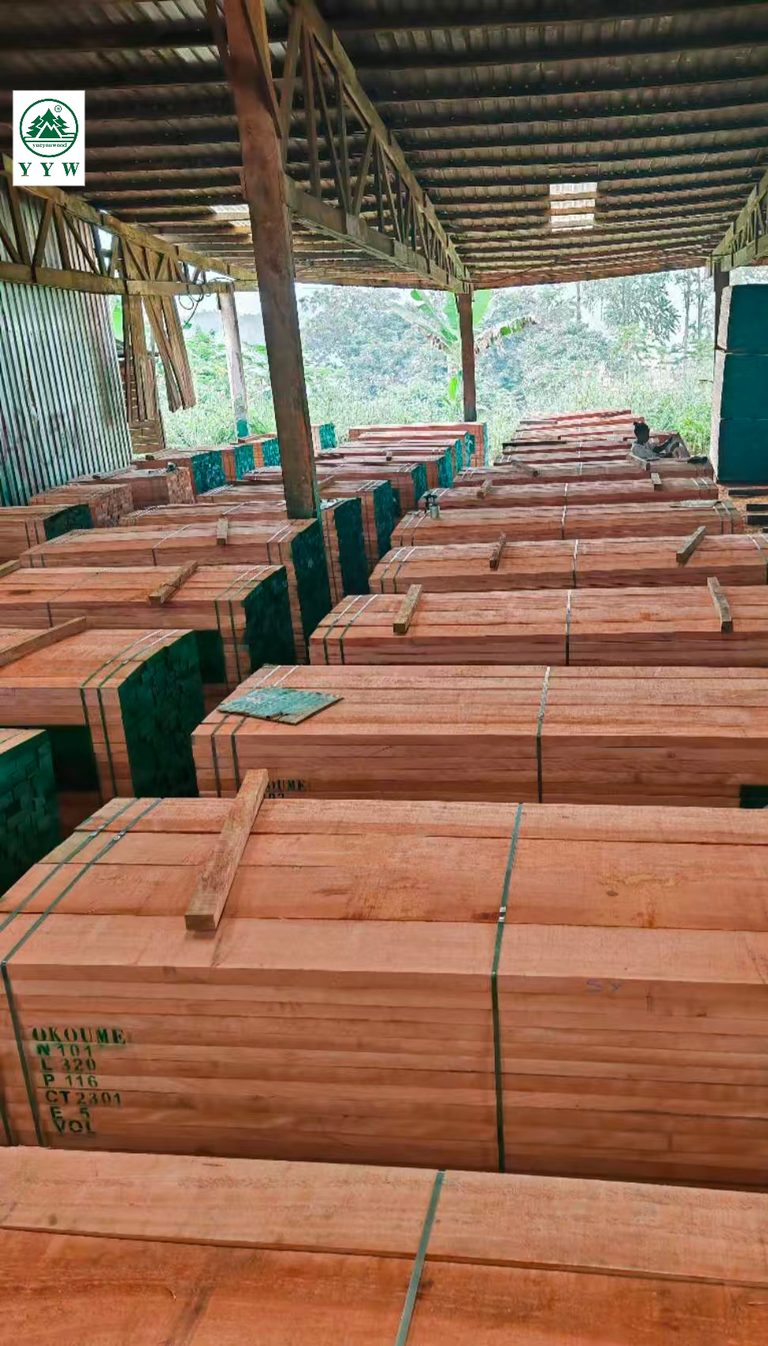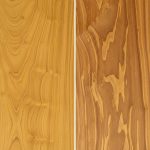
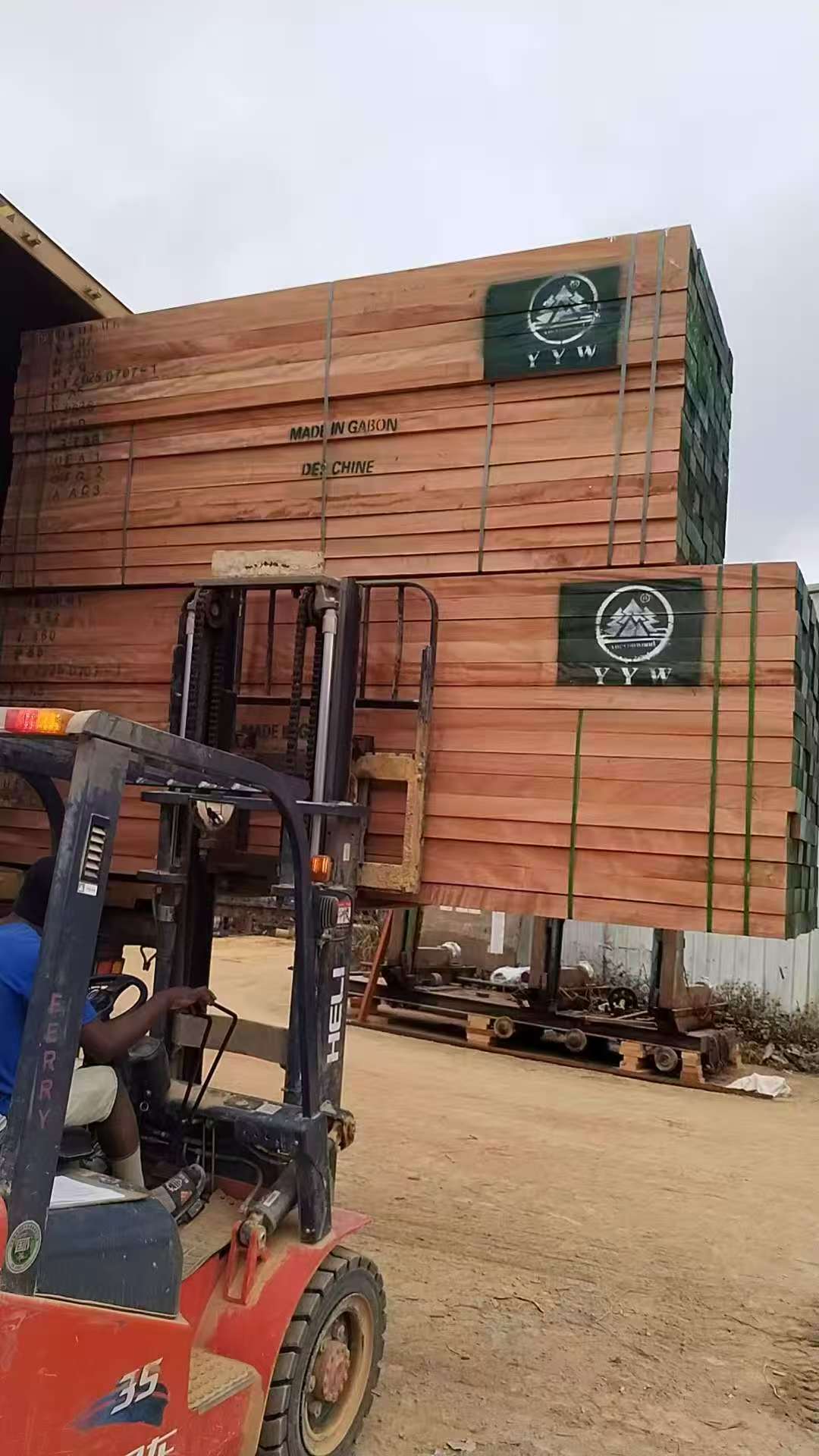
Okoume lumber (Aucoumea klaineana) is a premier tropical hardwood with an average dried density of 430 kg/m³. Gabon’s strict raw log export ban mandates in-country industrial processing prior to shipment. This commercial procurement guide examines technical grading specifications, kiln drying protocols, freight drivers, and international trade workflows for wholesale lumber buyers.
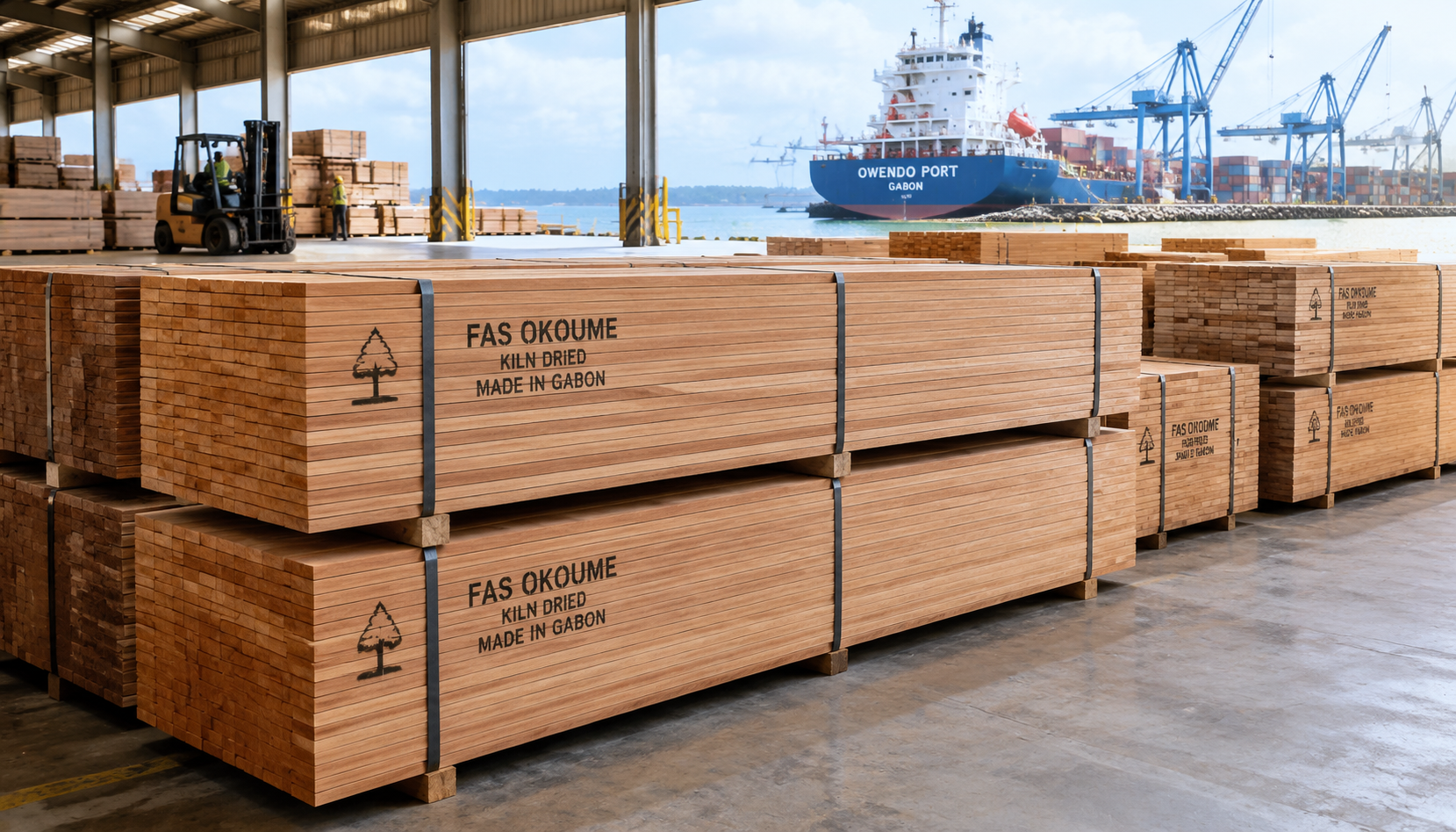
How Are Gabon Forestry Policies Shaping Okoume Global Supply?
Gabon implemented a comprehensive ban on raw log exports in 2010 to encourage domestic value-added timber processing. Consequently, international buyers can no longer import unprocessed round logs directly from Gabonese forests. According to trade data published by the International Tropical Timber Organization (ITTO), Gabon controls over 65% of the commercially viable Okoume reserves in Central Africa. This policy pivot forced a structural transition toward the export of rough-sawn lumber, rotary peeled veneer, and engineered plywood.
The establishment of the GSEZ (Gabon Special Economic Zone) at Nkok has centralized primary sawmilling operations near the capital city of Libreville. Industrial investments have standardized sawing precision across commercial processing facilities. As documented by the CIRAD Agricultural Research Centre, centralized timber manufacturing minimizes log waste by converting residual cuttings into industrial biofuel and core material. Consequently, recovery rates for rough-sawn lumber have risen from 32% under legacy operations to roughly 46% within modernized industrial clusters.
Procurement teams must also navigate environmental traceability standards. While Aucoumea klaineana is not restricted under the endangered species appendices maintained by CITES, Gabonese forestry law imposes rigorous concession quotas. Importers can cross-reference species protection metrics in the CITES Timber ID Repository to verify international trade legality. Forestry operators must hold certified concession approvals (CFAD) to legally secure harvest allocations. YYW Timber aligns its supply chain with these legal mandates, providing wholesale buyers with certified, fully traceable tropical lumber products.
Standard Dimensions and Grading Rules for Okoume Sawn Timber
Commercial grading for okoume timber adheres to modified rules established by the Association Technique Internationale des Bois Tropicaux (ATIBT) and the National Hardwood Lumber Association (NHLA). According to the USDA Forest Products Laboratory Wood Handbook, Okoume possesses a low-to-medium bending strength (modulus of rupture of 74 MPa) and a modest Janka hardness rating of 1,790 N (400 lbf). These properties make precise dimensioning vital for marine structural plywood, architectural paneling, and furniture framing.
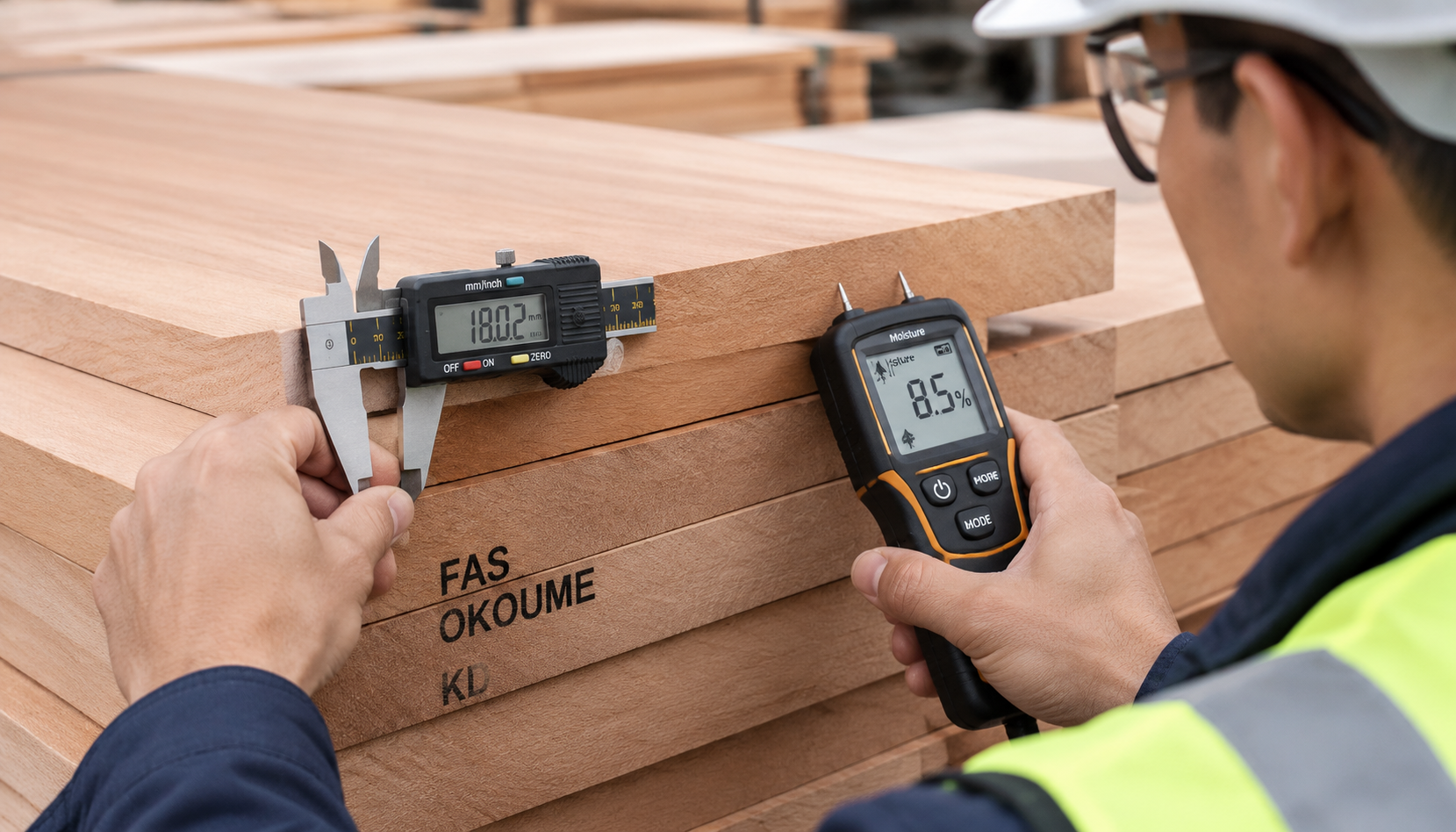
Exporters sort okoume wood for sale into distinct commercial tiers: FAS (First and Seconds), Selects, and No. 1 Common. As detailed in species assessments by TRADA, FAS grade demands an 83.3% minimum clear-face yield across the entire board surface. Buyers sourcing FAS okoume require boards largely free from pinhole borer channels, interlocked grain tears, heart shake, and wane. Conversely, No. 1 Common requires a 66.7% clear cutting yield, providing a cost-effective alternative for door core stock and secondary joinery applications.
| Commercial Grade | Standard Thickness (mm) | Standard Width (mm) | Standard Length (m) | Minimum Clear Yield (%) | Permitted Technical Defects |
|---|---|---|---|---|---|
| FAS (First & Seconds) | 25, 38, 50, 75 | 150, 200, 250+ | 2.40 to 4.50 | 83.3% | Occasional sound pin knots (<5mm); no wane, splits, or rot permitted. |
| Selects / FAS-1F | 25, 38, 50 | 100, 150, 200 | 2.10 to 4.00 | 83.3% (Best Face) | Minor heart shake permitted on back face; sound knots under 10mm allowed. |
| No. 1 Common | 22, 25, 38, 50 | 100, 125, 150 | 1.80 to 3.60 | 66.7% | Small pinhole borer marks, light interlocked grain tear, sound sapwood edges. |
| No. 2 Common / Core | 18, 22, 25 | 75, 100, 125 | 1.50 to 3.00 | 50.0% | Wane up to 10% of width, scattered pinholes, structural color variations. |
Physical profiles recorded by The Wood Database establish Okoume’s volumetric shrinkage at 10.7%, indicating exceptional dimensional stability once seasoned. Wholesale buyers sourcing custom thickness specifications should order with an allowance of +2mm to +3mm for rough green sawn timber to offset kiln shrinkage. Sawn lumber bundles typically range from 2.4 meters to 4.5 meters in length, packaged systematically according to standardized export bundle dimensions.
What Key Factors Drive Okoume FOB and CIF Price Fluctuations?
Procuring okoume lumber on international terms involves complex logistics calculations that dictate final landed pricing. As outlined in forestry cost surveys by Tropical Timber Info, raw stump-to-port logistics constitute approximately 38% to 45% of total Free On Board (FOB) Owendo production expenses. Timber concessions located in the remote Moyen-Ogooué and Ogooué-Maritime provinces incur substantial inland transport expenditures via river barges or rail corridors. Fuel price increases directly inflate domestic transit charges before the timber ever reaches maritime terminals.
Processing state creates the next major price divergence. Air-dried (AD) sawn lumber commands a lower baseline quotation than kiln-dried (KD) lumber. Operating thermal dry kilns within Gabon requires dedicated electricity or wood-waste co-generation capacity. Drying lumber from an initial green state down to 10%–12% moisture content typically adds $80 to $130 per cubic meter to export cost structures. However, commercial buyers recognize that unseasoned timber risks biological discoloration and mold growth during maritime passage, making KD lumber more economical overall.
| Cost Driver Component | Approximate % Share of FOB | Typical Cost Range (USD/m³) | Primary Economic & Operational Drivers |
|---|---|---|---|
| Stumpage Fees & Forestry Royalties | 12% – 16% | $55 – $80 | Gabon Ministry of Water and Forests extraction taxes and CFAD concessions. |
| Harvesting & Inland Haulage | 22% – 28% | $100 – $145 | Logging road maintenance, diesel costs, rail freight from inland logging sites. |
| Sawmilling & Grading Breakdown | 18% – 22% | $85 – $115 | Industrial processing at Nkok GSEZ, blade maintenance, primary recovery yield loss. |
| Kiln Drying (KD 10–12% MC) | 15% – 18% | $80 – $130 | Thermal energy generation, kiln holding time (10–14 days), moisture stabilization. |
| Port Handling & Phyto Certification | 8% – 12% | $40 – $65 | Owendo port stevedoring, fumigation, phytosanitary checks, customs inspection. |
| Ocean Freight (Libreville to EU/Asia) | Variable (CIF Factor) | $60 – $140 | Bunker Adjustment Factors (BAF), container chassis availability, destination fees. |
CIF (Cost, Insurance, and Freight) quotations fluctuate substantially alongside international maritime transport cycles. A standard 40-foot high-cube maritime shipping container accommodates approximately 38 to 44 cubic meters of tightly bundled Okoume sawn wood. Ocean freight spikes or port congestion surcharges at destination hubs directly affect unit costs per cubic meter. Importers must consistently verify Incoterms when negotiating supply agreements to protect purchasing margins against volatile transport tariffs.
Kiln Drying Schedules and Moisture Control to Prevent Honeycombing
Kiln drying okoume lumber requires precise thermodynamic regulation to safeguard the wood’s internal cellular structure. Green Okoume boards arrive at the kiln holding green moisture content (MC) levels between 60% and 85%. According to kiln drying research in the USDA Forest Service TreeSearch Repository, Okoume responds well to mild-to-moderate initial drying schedules. Rapid early-stage moisture extraction causes steep internal tension gradients, generating severe surface checking and internal honeycombing defects.
CIRAD engineering reports indicate that Okoume exhibits an exceptionally low tangential-to-radial shrinkage ratio (T/R ratio of 1.5). The radial shrinkage index measures 4.1%, while tangential shrinkage averages 6.1%. This favorable ratio indicates superior resistance to cupping and twisting relative to denser African species such as Iroko or Sapele. Nevertheless, operators must prevent casehardening by maintaining equilibrium moisture content through controlled humidity levels during early drying phases.
| Drying Phase | Moisture Content (MC) Range (%) | Dry Bulb Temp (°C) | Wet Bulb Temp (°C) | Relative Humidity (RH %) | Target Equilibrium MC (%) |
|---|---|---|---|---|---|
| Initial Warming / Heating | Above 60% (Green) | 45°C | 43°C | 90% | 18.5% |
| Stage 1 Moisture Removal | 60% down to 40% | 50°C | 46°C | 80% | 14.2% |
| Stage 2 Critical FSP Transition | 40% down to 25% | 55°C | 48°C | 70% | 11.5% |
| Stage 3 Core Desorption | 25% down to 15% | 62°C | 50°C | 55% | 8.8% |
| Final Conditioning & Relief | 12% down to 10% (Final) | 68°C | 60°C | 70% | 10.5% |
As outlined in research published via USDA TreeSearch Study 7142, maintaining kiln air circulation velocities at 1.8 to 2.2 meters per second prevents localized stagnation zones across board stacks. Once lumber attains its target moisture threshold of 10% to 12%, a 24-to-36-hour conditioning cycle equalizes core-to-shell moisture differentials. This stress-relief step eliminates residual internal drying stresses, allowing downstream manufacturers to rip, plane, and mold Okoume boards without warping.
Inspection and Quality Verification Before Loading Shipping Containers
Quality assurance protocols prior to container loading ensure that sawn Okoume lumber complies with purchase orders. Technicians execute pre-shipment inspections using calibrated multi-depth pin moisture meters. Standards maintained by international timber references such as the Wood Database Reference Index suggest sampling a minimum of five random sample boards per cubic meter. Moisture readings should not deviate beyond ±2% from the agreed specification across both core and shell profiles.
Physical inspections rigorously scan for pinhole borer markings and ambrosia beetle damage. While Okoume displays natural resistance to dry-wood termites, fresh-cut green logs remain susceptible to insect attack before drying. High-grade FAS consignments require complete absence of active infestations or excessive discoloration. Technicians verify that board ends have been coated with paraffin wax emulsions. This sealant reduces longitudinal moisture movement, preventing end checks during ocean transit.
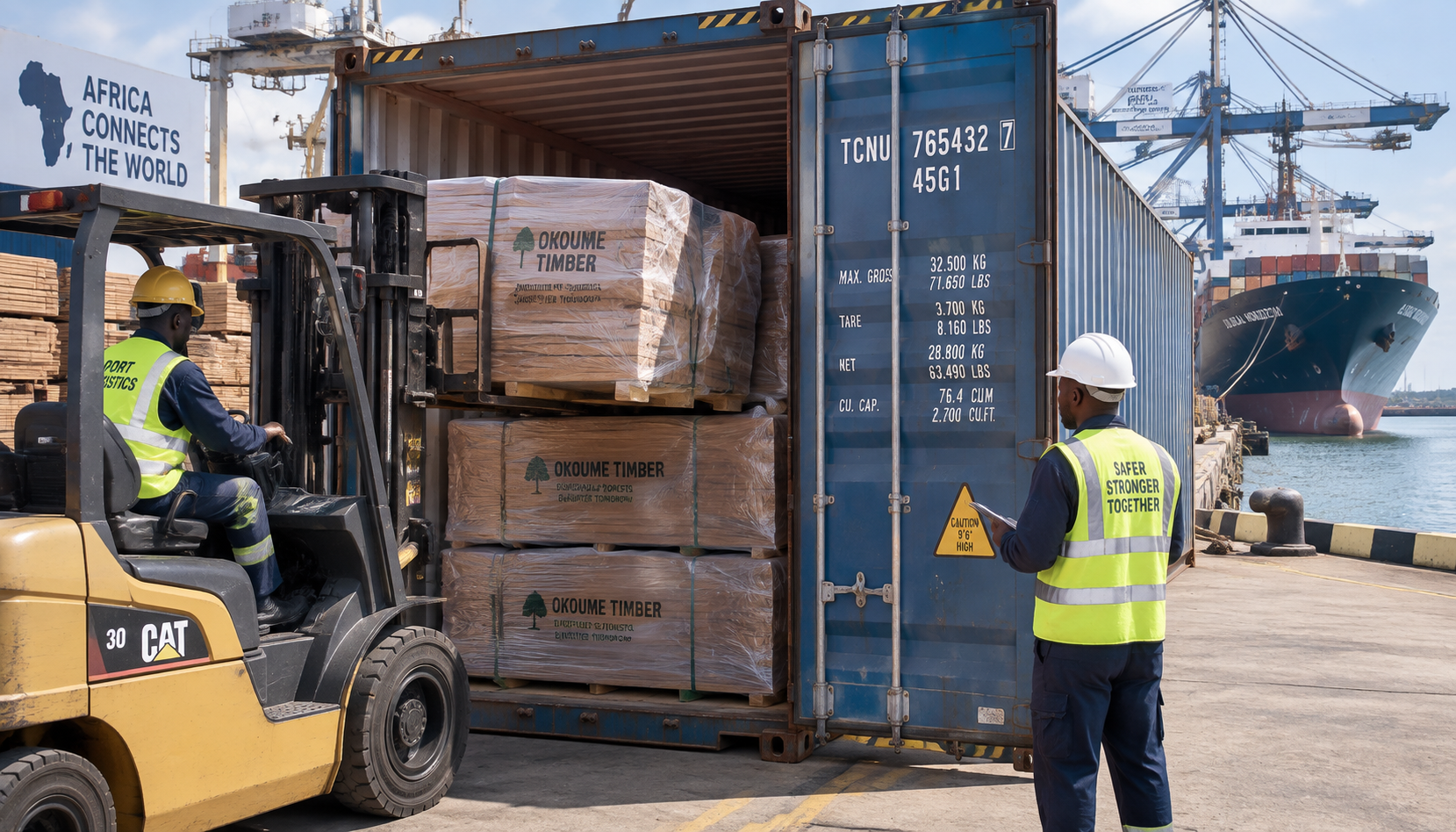
Container stuffing demands rigorous environmental mitigation to prevent moisture damage during maritime transit. Voyages traversing tropical waters to temperate destinations frequently generate internal condensation, known as “container rain.” Industrial suppliers mitigate this risk through several systematic loading practices:
- Applying industrial polyethylene protective wrap around timber bundles to block airborne humidity;
- Inserting high-capacity calcium chloride desiccant bags (2kg units) along container side-walls;
- Using seasoned treated wood dunnage beneath bottom bundles to isolate lumber from container floor moisture;
- Securing lumber bundles with heavy-duty polyester composite strapping to prevent shifting during transit.
How to Source Factory-Direct Okoume Logs and Lumber from YYW Timber
YYW Timber provides overseas buyers with an integrated procurement network across West and Central Africa. By managing commercial operations in strict compliance with Gabon forestry directives, we supply legally verified tropical hardwood products. International importers, architectural millwork suppliers, and industrial furniture builders partner with YYW Timber to secure consistent lumber dimensions without commercial intermediaries.
Our direct production capabilities include wholesale okoume logs processed into square-sawn boules, custom-dimensioned sawn boards, and precision-dried lumber. Every consignment undergoes systematic quality grading, kiln drying, and phytosanitary treatment before receiving maritime clearance at Owendo port. Buyers obtain complete documentation packages, including certified bills of lading, certificates of origin, and phytosanitary certificates.
Navigating global timber procurement requires reliable commercial supply partners and transparent trade execution. Browse our comprehensive catalogue of Okoume timber specifications and dimensions to align lumber options with your production requirements. Connect directly with our international trade specialists via our timber sales contact portal to receive competitive FOB and CIF quotations for the upcoming shipping season.
Frequently Asked Questions About Okoume Lumber Procurement
Can raw Okoume round logs still be exported directly from Gabon?
No. Gabon’s national forestry laws have prohibited the export of unprocessed round logs since 2010. All Okoume timber leaving the country must undergo primary or secondary industrial processing, such as conversion into sawn lumber, planed boards, rotary peeled veneer, or plywood panels. Sourcing raw Okoume logs requires purchasing through neighboring regional markets, such as Cameroon or the Republic of the Congo, subject to local export regulations.
What is the typical minimum order quantity (MOQ) for commercial Okoume sawn lumber?
The standard commercial minimum order quantity for factory-direct export is one 40-foot high-cube maritime shipping container. A standard 40-foot container holds approximately 38 to 44 cubic meters of kiln-dried, square-edged sawn timber, depending on board thickness and bundling configurations. Mixed-specification containers containing multiple standard thicknesses can be arranged under customized B2B agreements.
Why is Okoume the preferred species for marine-grade plywood manufacturing?
Okoume features an exceptional strength-to-weight ratio, an average dried density of 430 kg/m³, and a uniform, fine-textured grain that absorbs marine adhesive resins evenly. Its high dimensional stability (volumetric shrinkage index of 10.7%) prevents veneer core delamination under fluctuating ambient moisture, meeting the demanding structural requirements of the British Standard BS 1088 for marine plywood panels.
How does kiln-dried Okoume compare to unseasoned air-dried timber for furniture manufacturing?
Kiln-dried (KD) Okoume stabilized to 10%–12% moisture content eliminates the risk of post-assembly shrinkage, joint separation, and surface finish checking in indoor environments. Furthermore, controlled thermal kiln cycles sanitize the timber by destroying latent insect larvae and fungal spores, ensuring structural stability and meeting international plant health import regulations.