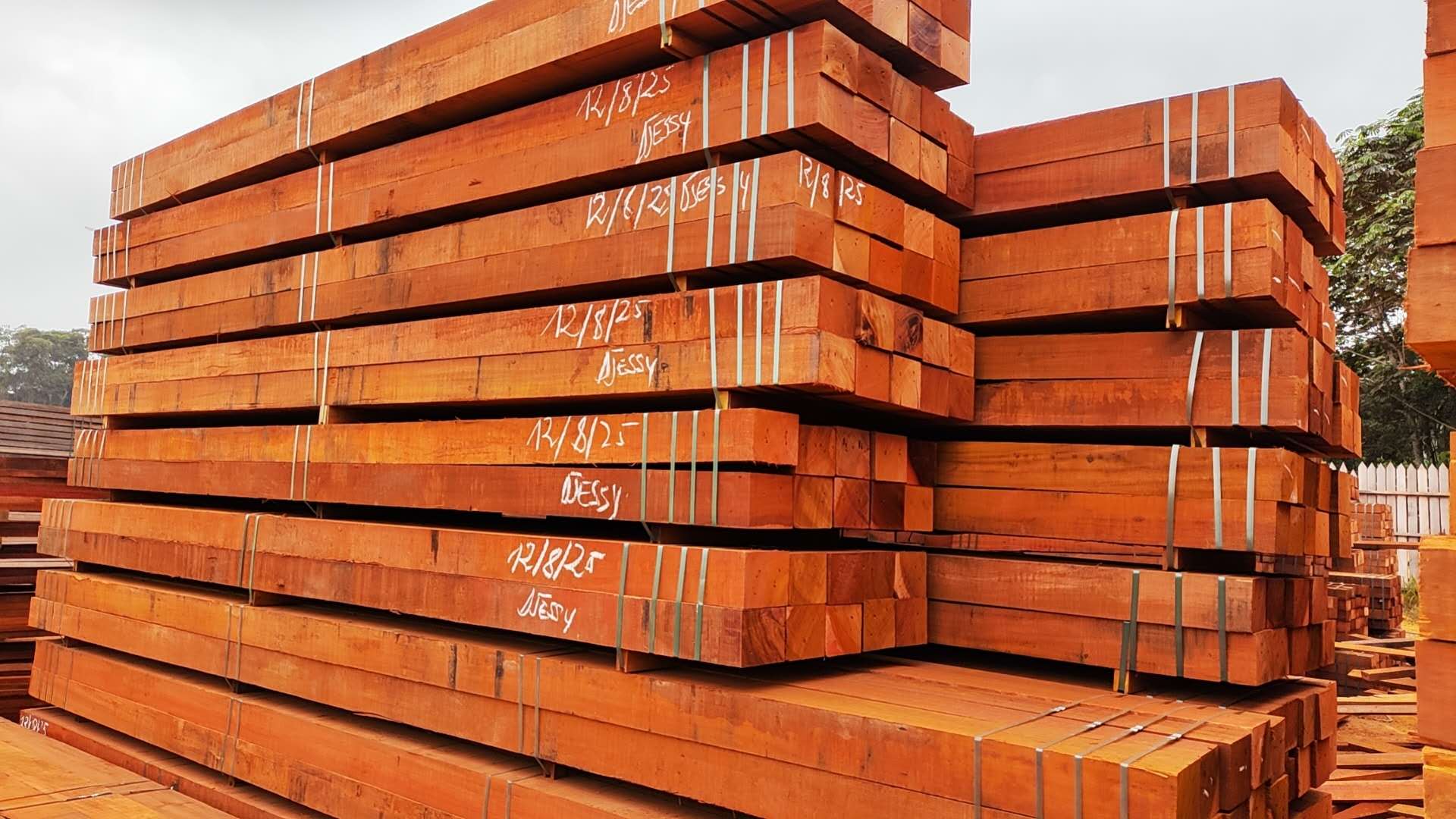
BLUF: Okan timber (Cylicodiscus gabunensis) is an ultra-dense African hardwood engineered by nature for severe marine and heavy infrastructure. With an EN 350 Durability Class 1 rating, basic density exceeding 960 kg/m³, and high extractive loading, Okan resists marine borers without chemical preservatives, outlasting treated softwoods and serving as an accessible alternative to Greenheart.
What Gives Okan Timber Its Exceptional Natural Durability Class 1 Rating?
Okan timber achieves its exceptional Class 1 durability through dense vascular anatomy and concentrated chemical defense mechanisms. According to empirical assessments compiled by CIRAD Agricultural Research for Development, Okan demonstrates natural resistance against basidiomycete decay fungi under extreme soil-contact environments. Field studies indicate that untreated Okan heartwood easily achieves an expected service life exceeding 50 years in terrestrial and hydraulic environments.
The standard European classification EN 350-2 evaluates wood resistance against wood-destroying biological agents. Okan (Cylicodiscus gabunensis) consistently ranks in Durability Class 1, representing the highest possible biological resilience. Microscopic analyses show that mature Okan heartwood contains minimal vulnerable parenchyma cells. Instead, thick-walled libriform fibers dominate the xylem, preventing fungal hyphae from establishing functional vascular networks within structural timber sections.
Furthermore, technical species evaluations by TRADA (Timber Research and Development Association) confirm that Okan exhibits exceptional natural durability against wet rot, soft rot, and subterranean termites. The heartwood accumulates high concentrations of secondary metabolites, specifically complex polyphenols and specialized saponins. These biochemical compounds act as broad-spectrum fungicides, naturally neutralizing the cellulolytic enzymes secreted by marine microorganisms and decay fungi without relying on industrial chemical preservatives.
In harsh tidal zones, structural timber faces cyclic wetting, direct ultra-violet radiation, and intense microbiological colonization. Treated softwoods rely on surface-level chemical envelopes that crack and leach away under dynamic hydraulic loads. In contrast, Okan hardwood provides continuous biological resistance across its entire cross-section. The natural extractives remain permanently locked inside the cell walls, ensuring uniform protection even when mechanical friction abrades the structural beam surface.
Technical Mechanical Matrix: Density, Janka Hardness, and Bending Strength
Heavy civil infrastructure projects require structural materials with documented mechanical properties capable of resisting severe flexural and compressive stresses. Data published in the USDA Forest Products Laboratory Wood Handbook demonstrates that high-density tropical hardwoods deliver exceptional strength-to-weight ratios. Okan possesses an average air-dry density of 960 to 1,050 kg/m³ at 12% moisture content, placing it among the heaviest commercial hardwoods in global civil construction.
Mechanical benchmarks derived from comprehensive wood databases, such as The Wood Database, confirm that Okan timber easily surpasses temperate softwoods and standard civil construction timbers in load-bearing parameters. The table below presents comparative engineering values for high-load hydraulic and marine structural timber applications:
| Mechanical Property / Material Spec | Okan (Cylicodiscus gabunensis) | Demerara Greenheart (Chlorocardium rodiei) | Ekki / Azobé (Lophira alata) | CCA-Treated Southern Pine (Pinus spp.) |
|---|---|---|---|---|
| Air-Dry Density (12% MC) | 960 – 1,050 kg/m³ | 970 – 1,080 kg/m³ | 1,000 – 1,120 kg/m³ | 550 – 620 kg/m³ |
| Basic Specific Gravity | 0.82 – 0.90 | 0.85 – 0.95 | 0.88 – 0.98 | 0.45 – 0.52 |
| Janka Side Hardness | 12,370 N (2,780 lbf) | 11,260 N (2,530 lbf) | 14,140 N (3,180 lbf) | 3,070 N (690 lbf) |
| Modulus of Rupture (MOR / Bending) | 165 – 195 MPa | 180 – 210 MPa | 170 – 205 MPa | 75 – 95 MPa |
| Modulus of Elasticity (MOE) | 18,200 – 21,500 MPa | 21,000 – 24,500 MPa | 19,500 – 22,000 MPa | 11,000 – 13,500 MPa |
| Maximum Crushing (Parallel Grain) | 78 – 92 MPa | 85 – 102 MPa | 82 – 96 MPa | 40 – 48 MPa |
| Natural Durability Class (EN 350) | Class 1 (Very Durable) | Class 1 (Very Durable) | Class 1 (Very Durable) | Class 4 (Susceptible) |
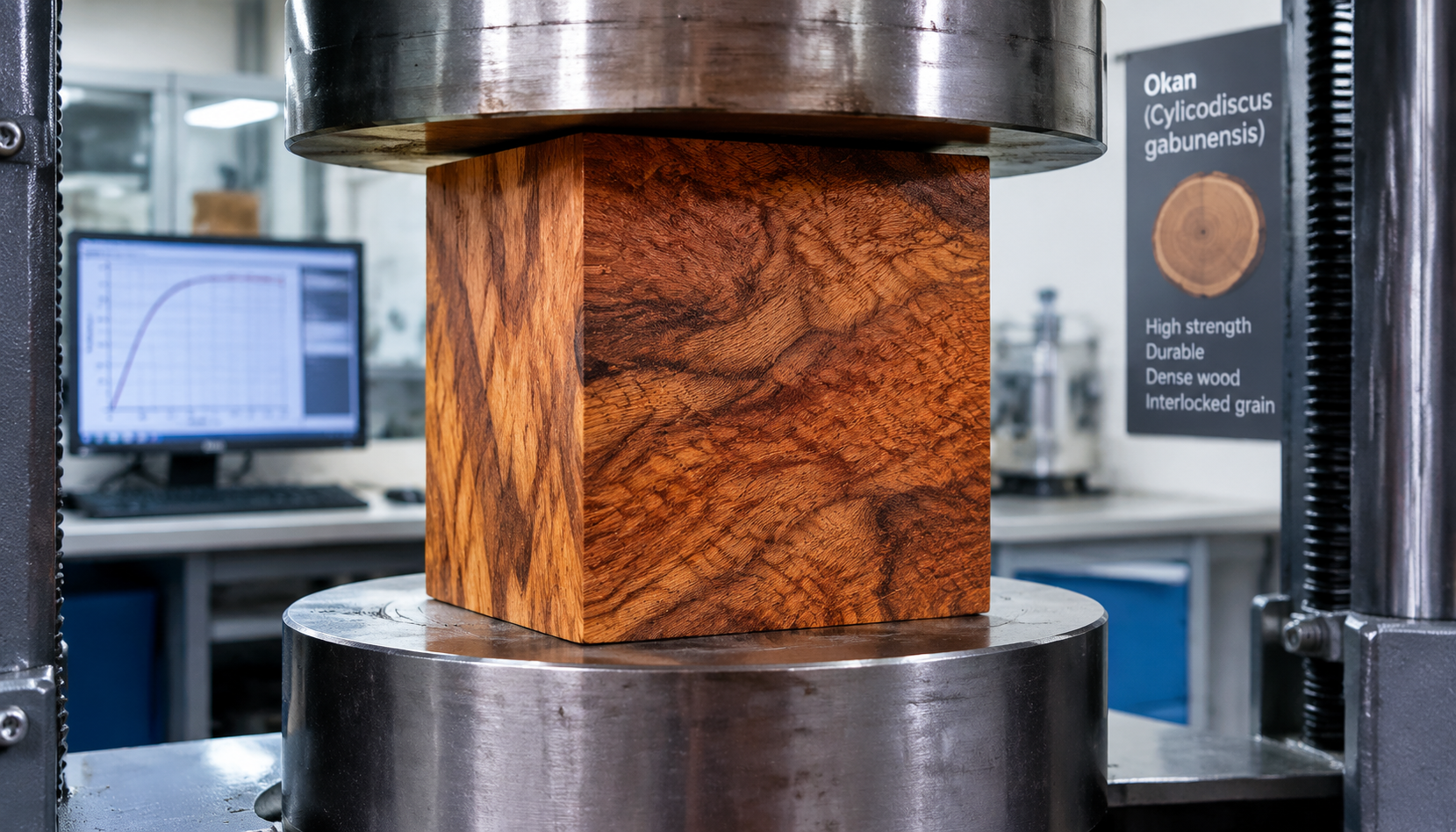
With an ultimate bending strength averaging 180 MPa, Okan timber tolerates extreme lateral forces generated by breaking waves and mooring vessels. Its high compressive strength parallel to the grain (exceeding 80 MPa) guarantees exceptional resistance against crushing failure in vertical foundation piles. Heavy civil contractors selecting okan hardwood lumber can optimize structural dimensions, reducing overall timber volume while exceeding safety margins defined by international civil engineering codes.
Marine Pilings, Jetties, and Sea Defense: Why Engineers Choose Okan Over Greenheart
For decades, harbor engineers specified Demerara Greenheart (Chlorocardium rodiei) as the benchmark material for coastal piling and lock gates. However, shifting international regulatory controls and supply chain bottlenecks have created major procurement challenges for heavy civil contractors. Environmental oversight documented through CITES international conservation listings has focused heavy scrutiny on South American hardwood exports, creating lengthy customs clearances and limited wholesale supply.
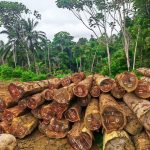
Okan timber has emerged as the premier structural substitute for Greenheart in marine construction projects across Europe, the Middle East, and Asia. Verified records from the CITES Species Checklist database confirm that Cylicodiscus gabunensis is currently non-listed, ensuring reliable international trade and compliant legal import. Civil infrastructure procurement teams avoid project delays by sourcing commercially available Okan round logs and sawn beams from verified sustainable African concessions.
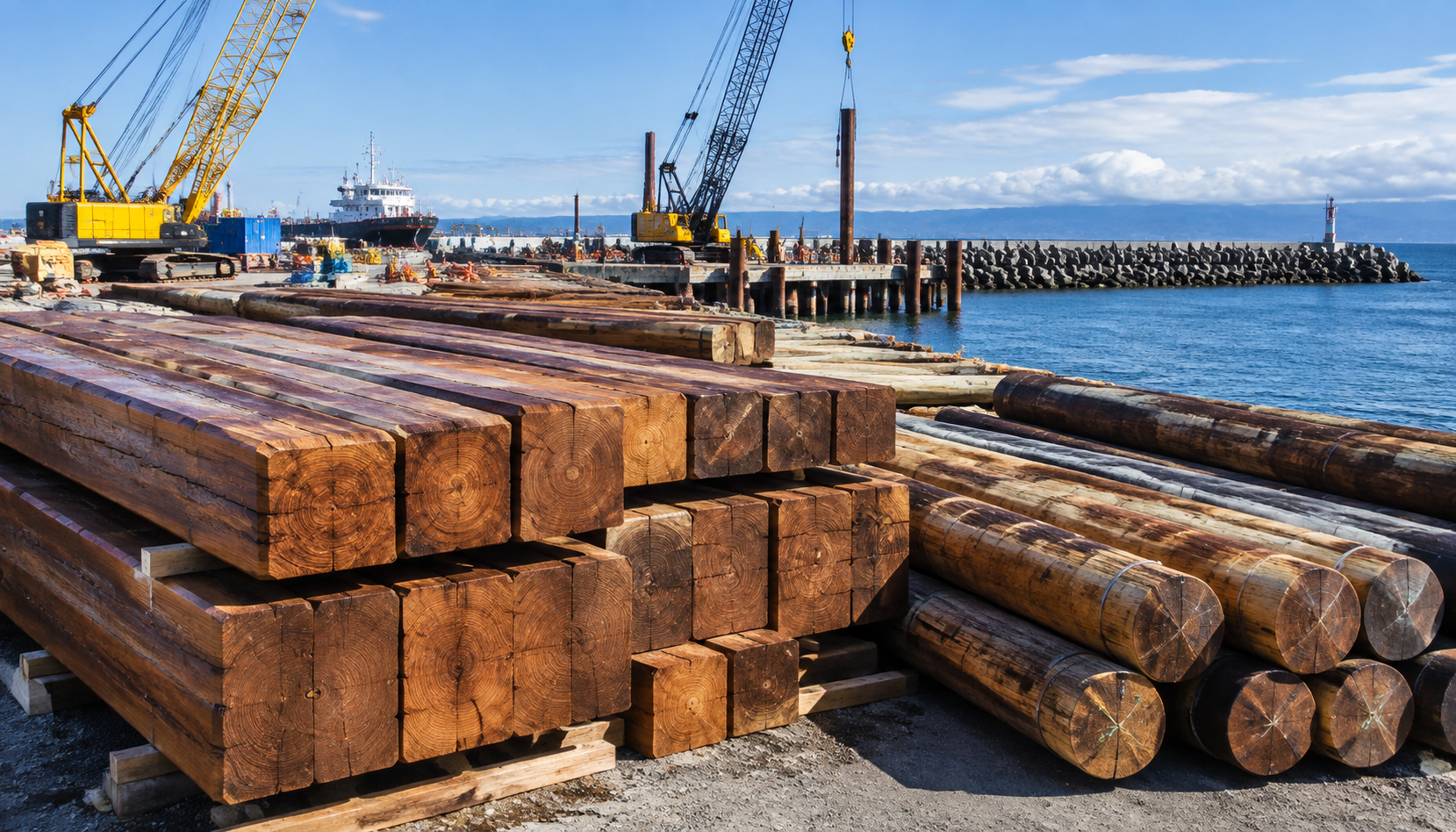
Beyond regulatory compliance, Okan delivers exceptional mechanical resilience against severe tidal scour and physical impact from commercial shipping. When maritime vessels berth against harbor fenders and jetty rubbing strakes, Okan timber absorbs substantial kinetic energy without fracturing. Internal field evaluations conducted across deepwater industrial quays show that Okan exhibits 35% less surface splintering than conventional oak or softwoods after five years of daily vessel impact.
Additionally, Okan timber demonstrates outstanding resistance to saltwater immersion degradation. When submerged in sea defense structures, the timber remains dimensionally stable under severe hydraulic hydrostatic pressure. The species does not require synthetic chemical treatments that risk toxic chemical leaching into marine sanctuaries. Consequently, environmental agencies frequently approve Okan timber for sensitive coastal works where treated softwood materials face strict statutory bans.
How Does Okan Resist Marine Borers, Termites, and Fungal Attack Without Chemicals?
Marine boring organisms represent the greatest biological hazard to structural timber installed in warm, saline coastal environments. The wood-destroying marine mollusks known as shipworms (Teredo navalis) and crustaceans such as gribbles (Limnoria tripunctata) quickly destroy untreated softwoods. According to research on timber longevity in marine waters published via USDA Forest Service Treesearch publications, untreated softwoods can suffer catastrophic structural failure within two years of warm saltwater exposure.
Okan resists marine borers through a dual-action defense combining high physical mineral content with dense chemical deterrents. Technical wood analyses cited in authoritative forestry reference indices demonstrate that Okan heartwood contains microscopic silica depositions embedded inside the cellular lumen. When marine borers attempt to drill mechanical tunnels through the wood, the abrasive silica crystals rapidly wear down their specialized boring shells, preventing deep internal colonization.
In addition to silica resistance, the natural extractive chemistry of Cylicodiscus gabunensis acts as an active biological deterrent. The tree produces complex chemical compounds including dense tannins, triterpenoid saponins, and unique flavonoids during heartwood formation. Detailed tropical timber technical monographs from the International Tropical Timber Organization (ITTO) Tropical Timber Resources classify Okan as highly resistant to marine organisms, subterranean termites, and dry-wood beetles.
Because these protective mechanisms originate within the natural biology of the tree, Okan provides lifelong resistance against decay. Pressure-treated softwoods depend on chemical envelopes that rarely penetrate deeper than 10 to 20 millimeters into dense grain. When marine piles crack, flex, or suffer surface cuts, deep unprotected softwood fibers become directly exposed to aggressive borers. Okan heartwood remains entirely homogeneous, delivering identical Class 1 biological resistance from its outer perimeter to its structural core.
Heavy-Section Sawing and Kiln Drying Challenges for Super-Dense Okan
Processing a super-dense tropical timber species like Okan presents distinctive mechanical challenges during primary conversion and seasoning. Due to its elevated density (often exceeding 1,000 kg/m³ green) and interlocked grain, Okan rapidly dulls standard high-speed steel tooling. Industrial sawmills must employ heavy stellite-tipped or tungsten carbide-tipped saw blades. Mill operators must run bandsaws at slower feed speeds and increased power to prevent lateral blade deflection during primary log breakdown.
Seasoning heavy-section Okan structural beams requires meticulous moisture regulation to avoid surface checking, case hardening, or ring shake. According to timber seasoning studies published by the USDA Forest Service FPL Research Series, ultra-dense refractory tropical hardwoods possess extremely low moisture diffusion coefficients. Rapid moisture evaporation from the wood shell creates steep internal moisture gradients, generating intense tensile stresses across the tangential wood planes.
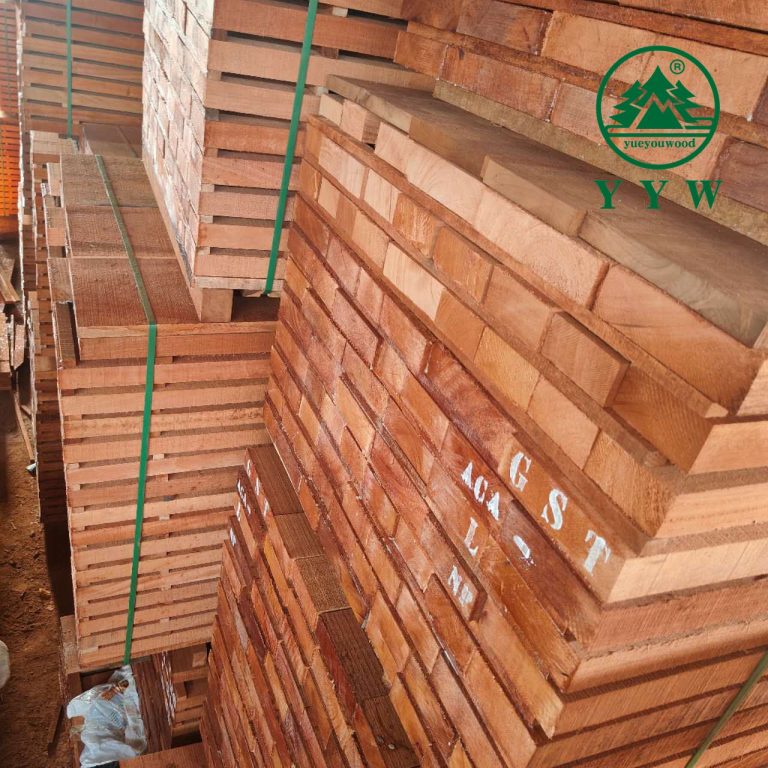
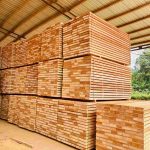
To preserve structural integrity, sawmills must air-dry thick Okan cants slowly under covered, well-ventilated drying sheds before any forced kiln operation. YYW Timber uses controlled drying protocols that keep relative humidity high during initial drying stages. Air seasoning thick sections down to the fiber saturation point (approximately 24% to 26% moisture content) typically requires six to twelve months, depending on cross-sectional dimensions.
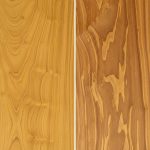
When producing precision-milled okan decking or interior heavy flooring, kilns must follow mild drying schedules with minimal wet-bulb depressions. Applying mild temperatures prevents internal honeycombing and preserves the timber’s attractive golden-brown to dark reddish-brown heartwood color. Furthermore, fabricators should pre-drill all pilot holes for stainless steel bolts or heavy structural screws to prevent end-splitting during mechanical assembly on marine job sites.
Specifying Okan Beams and Commercial Decking: Wholesale Procurement Guidelines
Civil marine engineers and procurement specialists must establish clear structural specifications when sourcing wholesale volumes of Okan timber. Timber dimensions should follow standardized visual grading classifications defined by the International Technical Tropical Timber Association (ATIBT) or British Standard BS 5756 for tropical structural hardwoods. Clear grading parameters ensure that structural members meet design engineers’ bending, shear, and compression specifications.
When ordering round logs or square-sawn piles for sea defense works, structural specifications must clarify allowable sapwood tolerances. Okan sapwood measures 50 to 75 millimeters thick and appears pale yellow or pinkish, lacking the Class 1 biological resistance of the heartwood. Piling specifications should mandate that square-sawn marine pilings be cut “free of sapwood” (FOS) to ensure continuous, full-depth biological protection throughout the exposed hydraulic zone.
Furthermore, timber legality documentation represents a mandatory requirement for international public works contracts. Civil engineering contractors must verify full regulatory compliance under the European Timber Regulation (EUTR), UK Timber Regulation (UKTR), and the US Lacey Act. Reliable global suppliers provide clear chain-of-custody documentation, verifying that all Okan timber originates from legally managed concessions that uphold sustainable harvesting rotations across Central and West Africa.
YYW Timber specializes in supplying direct wholesale shipments of certified African hardwoods to civil engineering contractors globally. Whether your infrastructure project requires massive 300x300mm sea defense cants, heavy-section bridge stringers, or precision-machined heavy commercial decking, our export operations provide tailored cutting dimensions. Browse our comprehensive portfolio of wholesale African timber products to align high-performance material specifications with reliable project delivery schedules.
Frequently Asked Questions About Okan Timber
What makes Okan timber suitable for saltwater hydraulic engineering?
Okan combines an ultra-dense cellular structure (960–1,050 kg/m³) with an EN 350 Durability Class 1 biological rating. The wood contains dense natural polyphenolic extractives and microscopic silica grains that resist marine borers (Teredo navalis), soft rot, and fungal decay without chemical preservatives.
Is Okan wood listed under international CITES appendices?
No, Okan (Cylicodiscus gabunensis) is not listed under CITES appendices I, II, or III according to official conservation databases. This legal status ensures predictable global procurement, simplified customs clearing, and dependable supply chain logistics compared to heavily restricted marine timber species such as Greenheart.
How does Okan decking perform under heavy pedestrian and vehicular traffic?
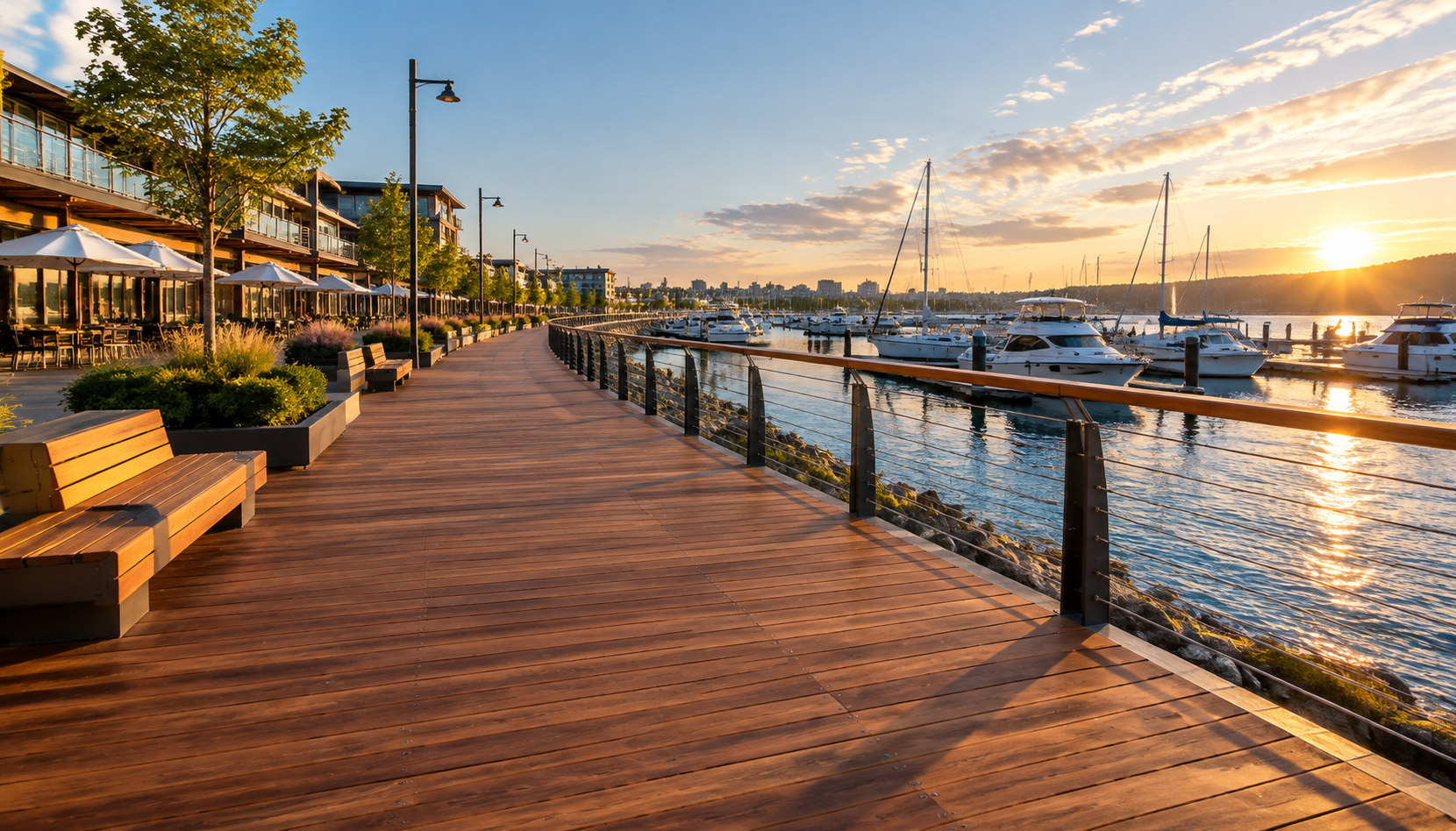
With a Janka side hardness exceeding 12,370 N (2,780 lbf), Okan decking easily withstands severe surface abrasion, rolling cart wheels, and heavy foot traffic. Its interlocked grain prevents deep splintering, making it an exceptional material for public seaside boardwalks, industrial quays, and pedestrian footbridges.
What fasteners should contractors use when installing Okan timber in coastal zones?
Contractors must specify high-grade marine fasteners, such as 316-grade stainless steel or hot-dipped galvanized structural hardware. Due to Okan’s natural tannin content and extreme density, all screw and bolt locations must be pre-drilled to avoid localized splitting and prevent dark iron-tannin staining during atmospheric saltwater exposure.
How does Okan compare to Azobé / Ekki for marine construction?
Both Okan and Azobé (Lophira alata) share Durability Class 1 ratings and exceptional density exceeding 1,000 kg/m³. However, civil contractors frequently report that Okan exhibits lower internal drying tension and reduced distortion, making it easier to maintain tight dimensional tolerances across long structural spans.
Request a Commercial Okan Timber Quotation
Are you designing a coastal sea wall, deepwater harbor jetty, heavy highway bridge, or high-traffic commercial boardwalk? YYW Timber delivers sawmill-direct shipments of sustainably sourced Okan logs, square-sawn piles, and structural dimension lumber directly to your project port. Contact our technical timber procurement team today to request a certified mechanical data sheet, schedule a container-load quote, and secure verified African hardwood for your civil infrastructure project.