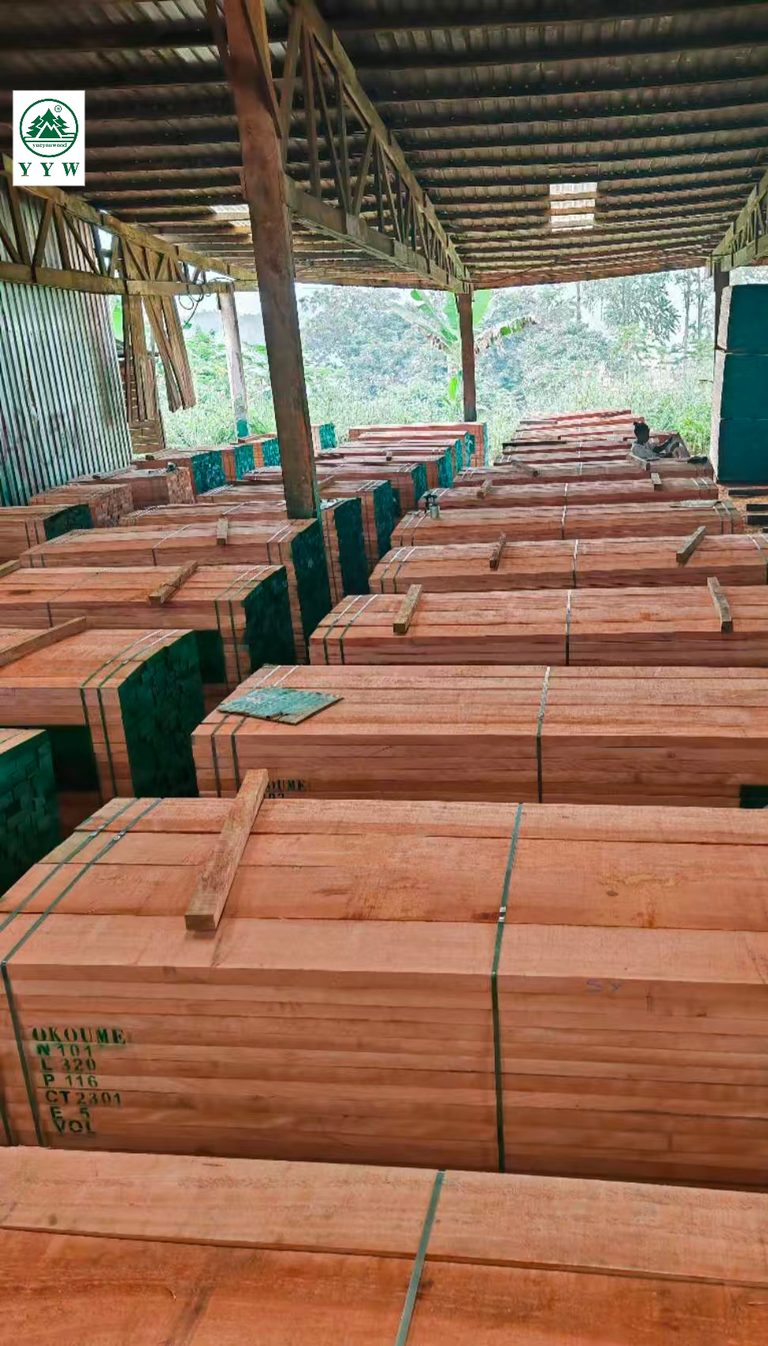
Okoume wood is an exceptionally uniform, low-density African hardwood engineered by nature for lightweight structural applications. Sourced primarily from Central Africa, its consistent grain, high strength-to-weight ratio, and excellent veneer-peeling yield make it the premier choice for marine plywood, recreational vehicles, and composite transportation panels where dimensional stability is essential.
What Makes Okoume Wood Naturally Lightweight and Stable?
Botanically classified as Aucoumea klaineana Pierre within the Burseraceae family, okoume wood thrives natively in the equatorial forests of West-Central Africa. The tree grows predominantly in Gabon, Equatorial Guinea, and the Republic of the Congo. Under optimal canopy conditions, mature trees attain clear, straight cylindrical boles that often reach heights exceeding 30 to 40 meters.
From an anatomical perspective, okoume is a diffuse-porous hardwood characterized by an extraordinarily homogeneous cellular structure. The wood vessels are evenly distributed across both earlywood and latewood zones. Because growth rings exhibit minimal cell wall thickening variations, internal stresses remain negligible across changing ambient humidity levels.
This anatomical uniformity directly resolves the classic engineering conflict between bulk density and structural warping. Traditional dense hardwoods resist deflection but impose severe weight penalties and internal tangential stress. Conversely, softwoods often suffer from localized density variations between rapid spring growth and dense summer bands. Okoume lumber avoids these localized stress concentrations entirely.
The interlocking grain structure of this lightweight hardwood provides balanced mechanical stability along multiple axes. When processors peel okoume veneer for industrial cross-laminated panels, the resulting sheets resist cupping, twisting, and surface checking. Consequently, engineered panels maintain planarity under dynamic environmental exposure, satisfying stringent manufacturing tolerances.
Key Physical & Mechanical Properties of Gabon Okoume
Evaluating raw timber for high-performance composite fabrication requires precise mechanical baseline data. Okoume timber presents an average air-dry density of approximately 430 kg/m³ at 12% moisture content. This low bulk mass places it squarely among the lightest commercially harvestable tropical hardwoods globally.
The structural efficiency of the species derives from its specific mechanical modulus relative to its density. While heavy structural hardwoods exhibit higher absolute failure loads, okoume delivers exceptional rigidity per unit of mass. This mechanical efficiency allows naval architects and vehicle chassis designers to specify thicker panel sections without encountering critical weight thresholds.
| Physical / Mechanical Property | Metric Value (Nominal) | Imperial Value (Nominal) | Standard Reference |
|---|---|---|---|
| Air-Dry Density (12% MC) | 430 kg/m³ | 26.8 lb/ft³ | ISO 3131 / ASTM D143 |
| Basic Specific Gravity | 0.36 to 0.40 | 0.36 to 0.40 | Oven-dry mass / green volume |
| Bending Strength (Modulus of Rupture – MOR) | 75 MPa | 10,875 psi | ISO 3133 / ASTM D143 |
| Modulus of Elasticity (MOE) | 10,200 MPa | 1,479,000 psi | ISO 3349 / ASTM D143 |
| Radial Shrinkage (Green to Oven-Dry) | 4.1% | 4.1% | ISO 4859 |
| Tangential Shrinkage (Green to Oven-Dry) | 6.1% | 6.1% | ISO 4859 |
| T/R Shrinkage Ratio | 1.49 | 1.49 | Dimensional Stability Index |
| Janka Side Hardness | 1,700 N | 382 lbf | ASTM D143 |
| Natural Durability Class | Class 4 (Slightly Durable) | Class 4 (Slightly Durable) | EN 350-2 Standard |
The tangential-to-radial (T/R) shrinkage ratio remains one of the most critical metrics for composite stability. Okoume maintains a favorable T/R ratio below 1.6. Lower differential shrinkage between radial and tangential wood planes significantly lowers internal drying stresses, eliminating face checking in finished plywood panels during seasonal climatic shifts.
Why Do Boatbuilders and RV Manufacturers Specify Okoume Plywood?
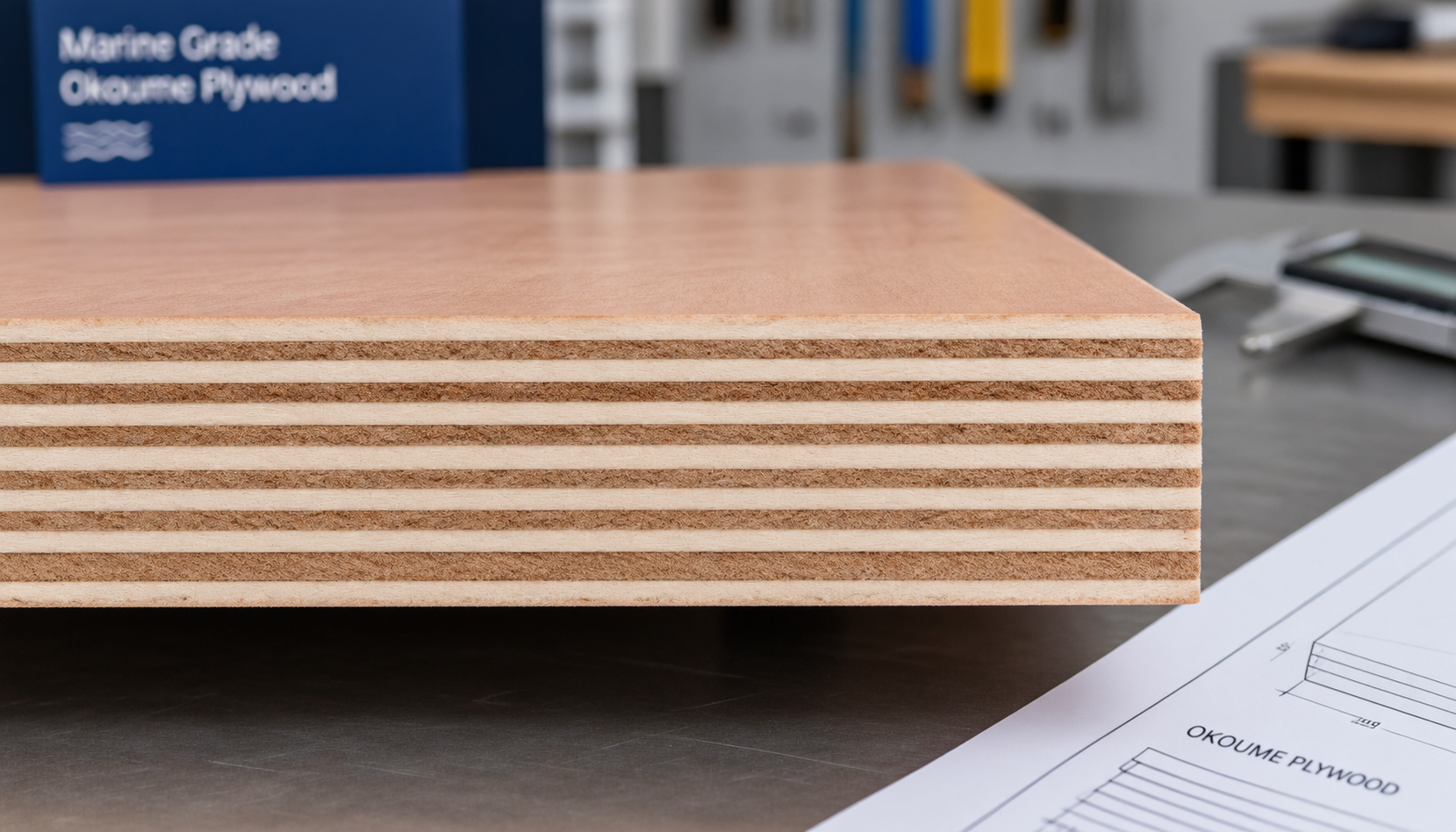
Marine boatbuilders specify okoume plywood because naval architecture requires strict weight optimization without sacrificing structural resilience. When constructing yacht hulls, bulkheads, stringers, and deck subflooring, hull weight directly dictates vessel performance. Excessive hull displacement consumes propulsion energy, slows acceleration, and compromises high-speed maritime handling characteristics.
By engineering panels with uniform okoume cores, shipwrights achieve marine structural certifications such as BS 1088. The consistent veneer density prevents internal voids and telegraphing across exterior hull skins. Furthermore, the diffuse-porous structure exhibits exceptional resin absorption when paired with marine epoxy matrices, creating monolithic composite laminates that resist delamination.
In recreational vehicle (RV) and overland camper manufacturing, vehicle curb weight determines payload compliance and towing efficiency. Manufacturers replace heavy particleboards or standard dense plywood with okoume core sandwich panels for slide-out floors, interior cabinetry, and ceiling liners. Reducing interior dry weight provides consumers with expanded cargo capacity while keeping vehicles within legal gross vehicle weight ratings (GVWR).
Additionally, modern off-road campers face relentless road vibrations and torsional flexing during travel. Poplar cores frequently suffer screw pull-out failures under mechanical strain, whereas dense tropical timbers overload vehicular suspension systems. Okoume offers the ideal engineering balance, providing resilient screw holding capacity and mechanical fatigue resistance alongside substantial mass reduction.
Machining, Gluing, and Rotary Peeling Performance in Industrial Processing
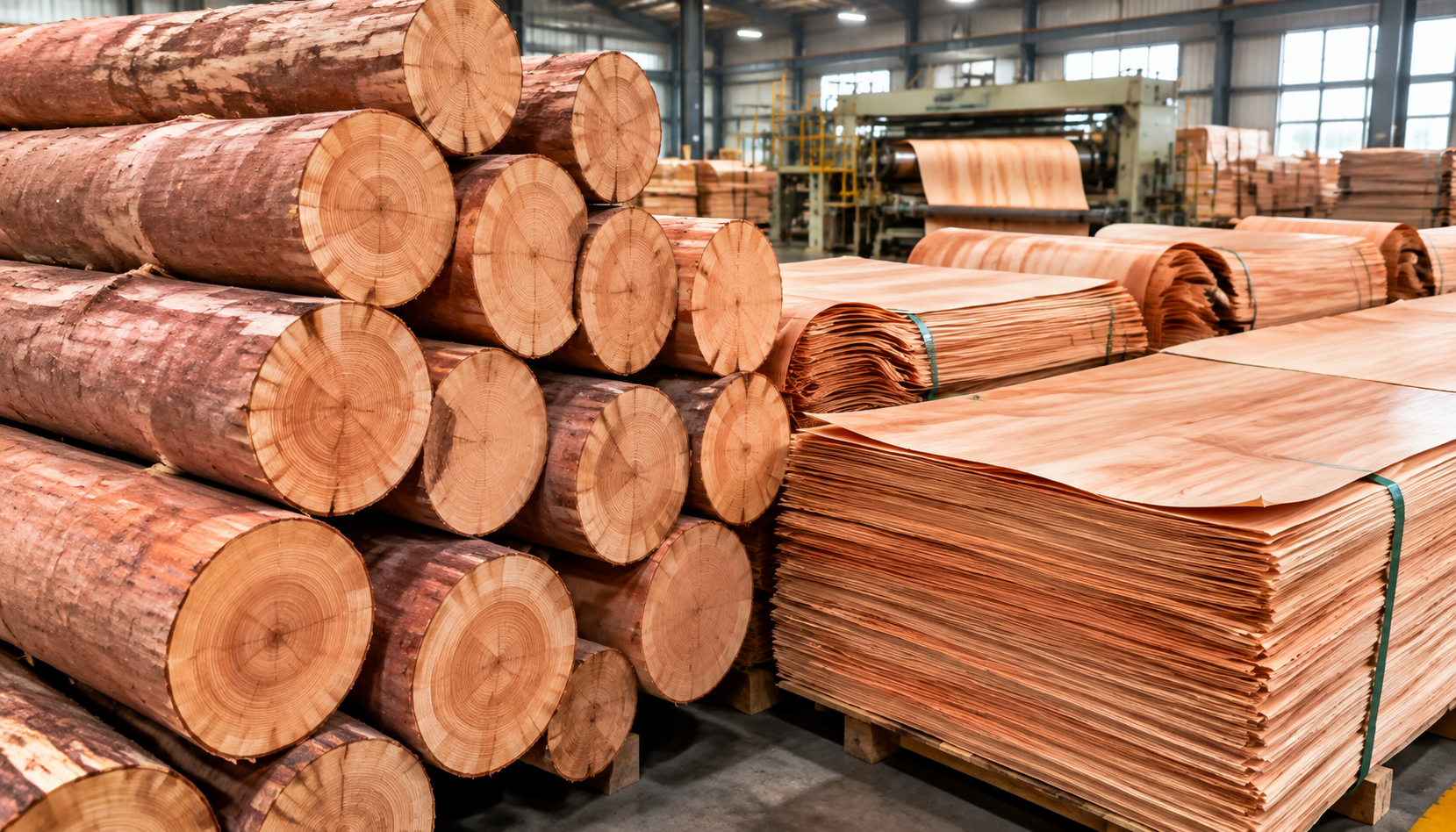
Plywood factory procurement managers prize okoume logs and timber because the species demonstrates superior yield efficiency on high-speed rotary peeling lathes. Freshly debarked round logs peel cleanly into continuous, paper-thin veneer ribbons without requiring aggressive hydrothermal boiling pre-treatments during temperate processing periods.
The veneer ribbon displays tight lathe checks and uniform thickness tolerances across large log diameters. Low natural silica content ensures minimal abrasion against high-speed lathe knives, preserving knife sharpness and maximizing operational uptime. Factory lines experience minimal sheet tearing or grain pull-out, which drastically lowers core veneer splicing labor and material waste.
Adhesive compatibility represents another distinct factory advantage. The absence of volatile resins, heavy pitch pockets, or oily surface extractives promotes deep chemical wetting. Okoume logs bond reliably with standard exterior phenol-formaldehyde (PF), melamine-urea-formaldehyde (MUF), and modern structural polyurethane (PUR) resin adhesives, consistently achieving 100% wood failure in standardized boiling-water-proof (BWP) shear tests.
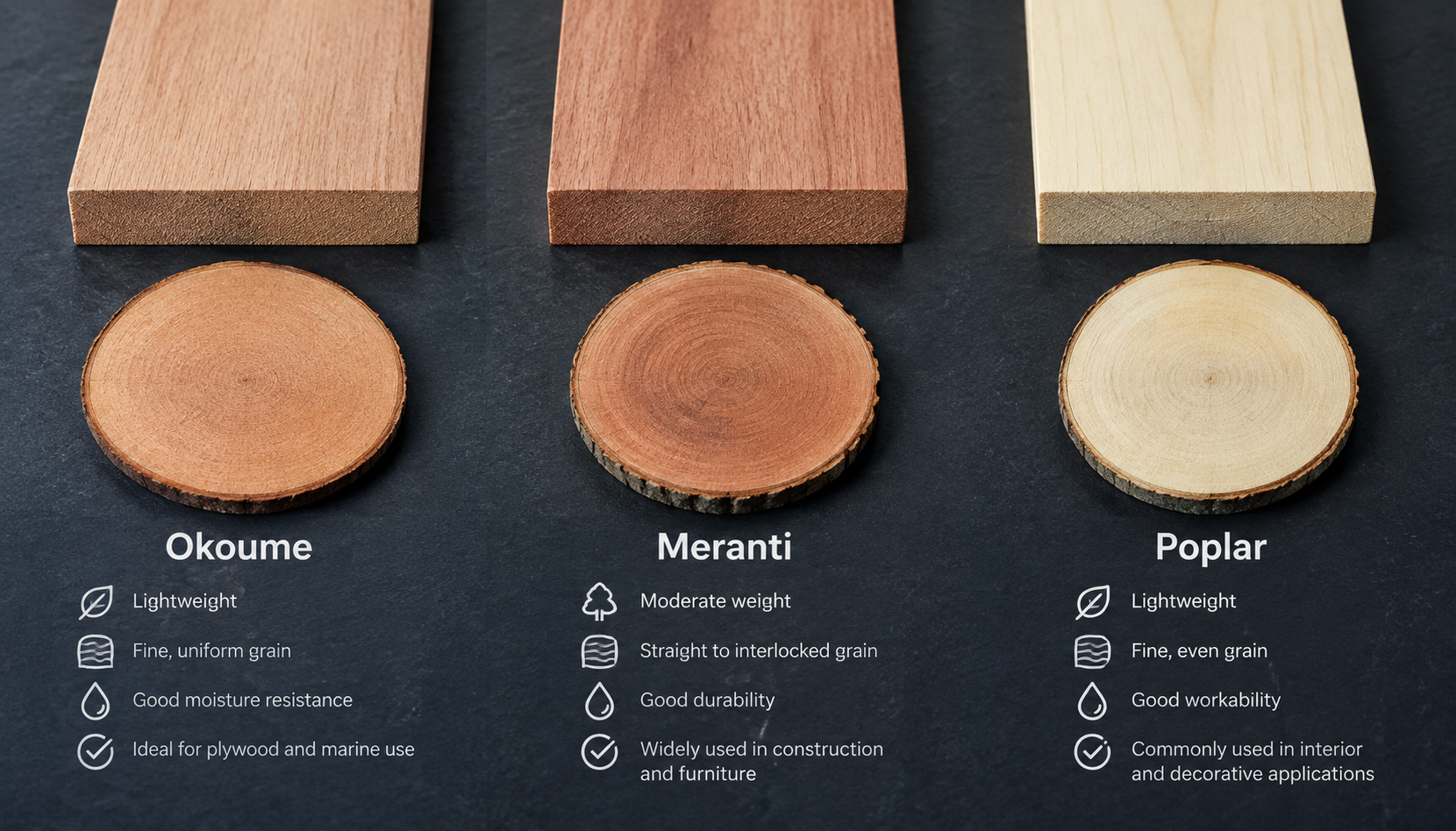
How Does Okoume Compare to Meranti and Poplar Plywood Cores?
Core substrate selection dictates panel rigidity, final bundle weight, and finishing cost. Factory procurement teams frequently balance okoume against European poplar and Southeast Asian red meranti. Selecting the correct core material requires balancing bulk weight limits against bending strength and face smoothness.
| Core Material Comparison | Gabon Okoume Core | Southeast Asian Meranti Core | European Poplar Core |
|---|---|---|---|
| Air-Dry Density Range | 380 – 450 kg/m³ | 550 – 720 kg/m³ | 350 – 420 kg/m³ |
| Bending Elasticity (MOE) | Medium-High (Balanced) | High (Heavy deflection resistance) | Low to Medium (Flexible) |
| Surface Grain Uniformity | Very High (Diffuse-porous) | Coarse to Medium (Vessel lines) | Medium (Prone to wooliness) |
| Screw Withdrawal Force | Balanced for RV cabinetry | High structural grip | Low (Risk of pull-out failure) |
| Veneer Telegraphed Grain | Minimal (Smooth face veneer) | Moderate to High telegraphing | Low surface grain telegraphing |
| Primary Industrial Roles | Marine vessels, RV liners, luxury doors | Heavy container floors, scaffolding | Budget interior packaging, furniture |
While European poplar achieves a low density profile comparable to okoume, it lacks the modulus of rupture needed for load-bearing marine structures. Poplar veneers also suffer from fibrous “woolliness” during industrial sanding, creating micro-voids beneath thin face veneers. Conversely, dark red meranti delivers robust mechanical failure limits but imposes a 30% to 50% mass penalty on structural assemblies.
Okoume wood occupies the precise engineering middle ground between these substrates. It eliminates the excessive tare weight of meranti while outperforming poplar in screw retention, surface smoothness, and dimensional recovery. For lightweight transit panels requiring decorative veneer or laminate overlays, okoume eliminates uneven face telegraphing completely.
Sourcing Certified Okoume Logs and Sawn Timber: Commercial Procurement Checklist
Securing consistent container volumes of high-grade okoume requires strict adherence to international forestry compliance and dimensional grading standards. Importers must confirm chain of custody and verify government-sanctioned concession quotas before placing container contracts.
Commercial buyers should systematically audit suppliers using the following technical procurement parameters:
- Log Sizing & Geometry: Specify minimum diameter classes of 60 cm to 80 cm+ for high-yield rotary peeling lathes, ensuring cylindrical logs with centered hearts.
- Grading Verification: Inspect logs under ATIBT (Association Technique Internationale des Bois Tropicaux) grading rules, distinguishing between veneer grade (Loyal & Marchand) and standard sawlog grades.
- Kiln Drying Moisture Targets: Order containerized sawn lumber dried to 10% – 12% moisture content (KD) to avoid mold and dimensional deformation during ocean freight.
- Phytosanitary & Legal Documentation: Validate country-of-origin export permits, official phytosanitary fumigation certificates, and European Timber Regulation (EUTR) or CITES documentation where applicable.
- Container Optimization: Calculate 40-foot High Cube container stuffing volumes, balancing cubic meter limits against local road weight limits at the destination port.
Frequently Asked Questions About Okoume Wood
Is okoume wood naturally rot-resistant in exterior marine environments?
No, okoume heartwood is classified as slightly durable (Class 4). In marine yacht building, builders encapsulate okoume panels within waterproof marine epoxy barriers or phenolic films to achieve indefinite service lives in salt water environments.
Why is okoume preferred over Baltic birch for lightweight RV components?
Baltic birch has an average density of approximately 650 to 700 kg/m³, making it nearly 50% heavier than okoume. Switching to okoume core panels significantly cuts structural chassis load without compromising interior stability.
Can solid okoume lumber be used for exterior architectural joinery?
Solid okoume lumber works well for exterior joinery provided fabricators seal all end grain and apply weather-protective industrial coatings. Its exceptional dimensional stability minimizes joint separation caused by seasonal thermal cycles.
What are the standard log lengths available for commercial export?
Commercial okoume logs are typically cross-cut to lengths between 5.8 and 11.8 meters to optimize stowage inside standard 20-foot and 40-foot shipping containers.
Procure Factory-Direct Okoume Timber and Veneer from YYW Timber
YYW Timber specializes in the sustainable supply and export of certified African hardwoods directly to international manufacturers, marine shipyards, and commercial plywood mills. We manage rigorous sorting, kiln drying, and containerized logistics to guarantee precise moisture limits and high log yields. Contact our engineering and commercial sales division today to request technical data sheets or receive a prompt container-load quotation for your next manufacturing run.