Timber moisture content (MC) directly affects dimensional stability, strength, workability, and resistance to decay. For system integrators and buyers, understanding MC is critical to ensure product performance and avoid costly failures. This guide covers measurement methods, equilibrium moisture content (EMC), recommended levels for applications, and practical handling tips.
Key Takeaways
- Moisture content is the weight of water as a percentage of oven-dry wood weight.
- Target MC depends on final use: 6–8% for indoor furniture, 9–12% for construction lumber, 12–16% for outdoor applications.
- Equilibrium moisture content is determined by ambient temperature and relative humidity.
- Accurate measurement requires a moisture meter or oven-dry method.
- Improper MC leads to warping, cracking, mold, and joint failure.
- System integrators should specify MC on purchase orders and verify upon receipt.
What Is Timber Moisture Content and Why Does It Matter?
Moisture content is defined as the weight of water contained in wood expressed as a percentage of the oven-dry weight of the wood fibre. It is mathematically represented as:
MC (%) = (Wet weight – Oven-dry weight) / Oven-dry weight × 100
Freshly sawn timber (green) often has MC above 50% (or even over 100% for some species). For structural use or manufacturing, MC must be reduced to levels appropriate for the environment. Failure to do so can cause dimensional changes (shrinkage or swelling), warping, checking, loss of strength, and biological degradation.
How Is Moisture Content Measured in Timber?
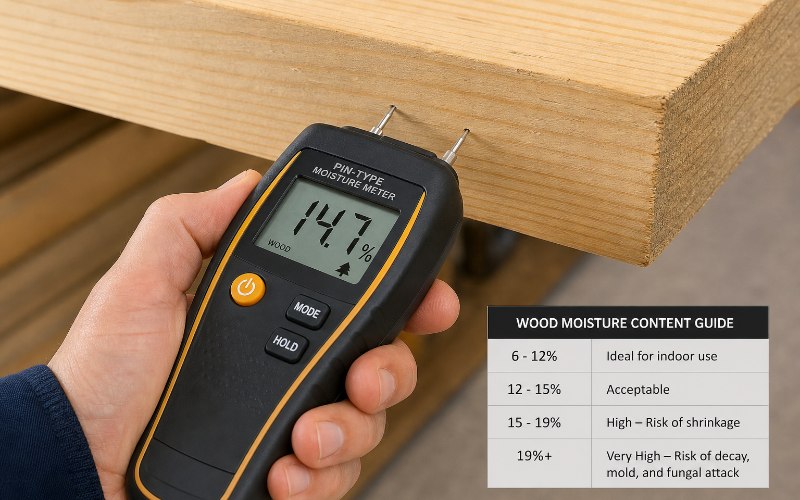
Two primary methods exist: the oven-dry method (gravimetric) and the use of moisture meters. The oven-dry method is the most accurate but destructive and time-consuming. Moisture meters provide quick, non-destructive readings and are standard for quality control. Two types dominate:
- Pin-type meters: Insert electrodes into the wood; measure electrical resistance, which varies with MC. Best for lumber up to 30% MC.
- Pinless meters: Use electromagnetic waves to scan surface; faster but less accurate for deep moisture gradients.
Calibration is critical—different species and temperature corrections may be needed. For B2B purposes, specify the measurement standard (e.g., ASTM D4442, EN 13183).
Expore more about How to Measure Moisture Content of Wood
The Importance of Equilibrium Moisture Content (EMC)
EMC is the MC at which wood neither gains nor loses moisture when exposed to a given relative humidity (RH) and temperature. Wood is hygroscopic; it will adjust to reach equilibrium. For example, at 20°C and 65% RH, most softwoods have an EMC of about 12%. EMC ranges for typical indoor environments in temperate climates are 8–14%, while tropical controlled spaces may be 9–12%.
System integrators must ensure that timber MC matches the expected in-service EMC to minimise movement and degradation. Pre-conditioning lumber to target MC prior to installation is a common best practice.
Moisture Content Standards and Grades
Worldwide standards define acceptable MC ranges for various timber applications. Common references include:
| Standard | Region | Typical MC Range |
|---|---|---|
| ASTM D4442 | USA | 9–12% for general use |
| EN 942 | Europe | 8–10% for interior |
| JAS 5104 | Japan | 10–14% for structural |
| BS 4978 | UK | 12–16% for construction |
Understanding which standard applies to your project is essential. Many international importers require a certification of MC compliance.
Effects of Moisture Content on Wood Properties
MC influences:
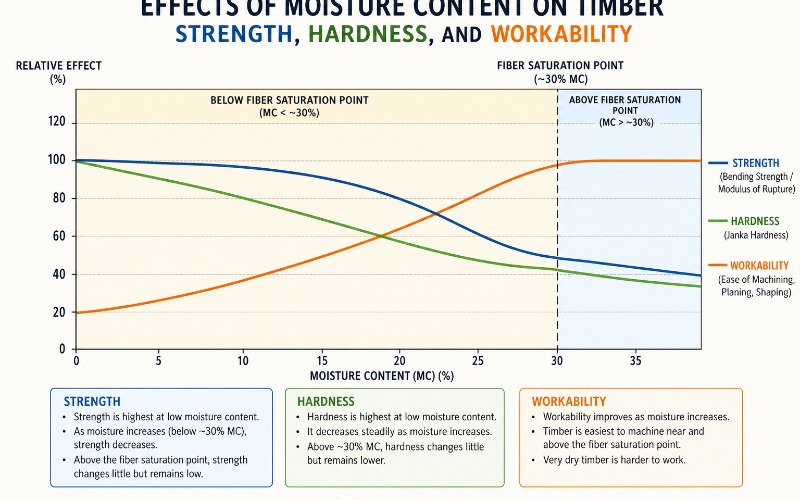
- Strength: Both increased stiffness and bending strength occur as MC decreases below fibre saturation point (FSP, ~28%).
- Hardness: Dry wood is harder and more resistant to indentation.
- Workability: Wood with lower MC machines cleaner, but too low can cause chipping.
- Durability: High MC promotes fungal decay and insect attack.
- Glue adhesion: Most adhesives require MC between 6–12% for optimal bonds.
Drying Processes and Challenges
Kiln-drying is the industrial standard. Air-drying is slower and dependent on climate. For kiln-drying, temperature and humidity schedules are species-specific. Common challenges include:
- Casehardening: Surface dries and compresses while core retains moisture; results in tension set and possible warping.
- Checking and splitting: Especially in dense hardwoods; requires careful control of initial conditions.
- Collapse: Severe shrinkage in some species due to internal stress.
- Uniformity: Achieving consistent MC throughout a stack is difficult but essential for quality.
Quality control during drying should include frequent moisture meter checks and stress tests (e.g., fork test).
Learn more about KD vs AD Iroko Lumber
Best Practices for Handling and Storage
Once timber is dried to target MC, it must be kept stable:
- Store in covered, ventilated area away from direct moisture sources.
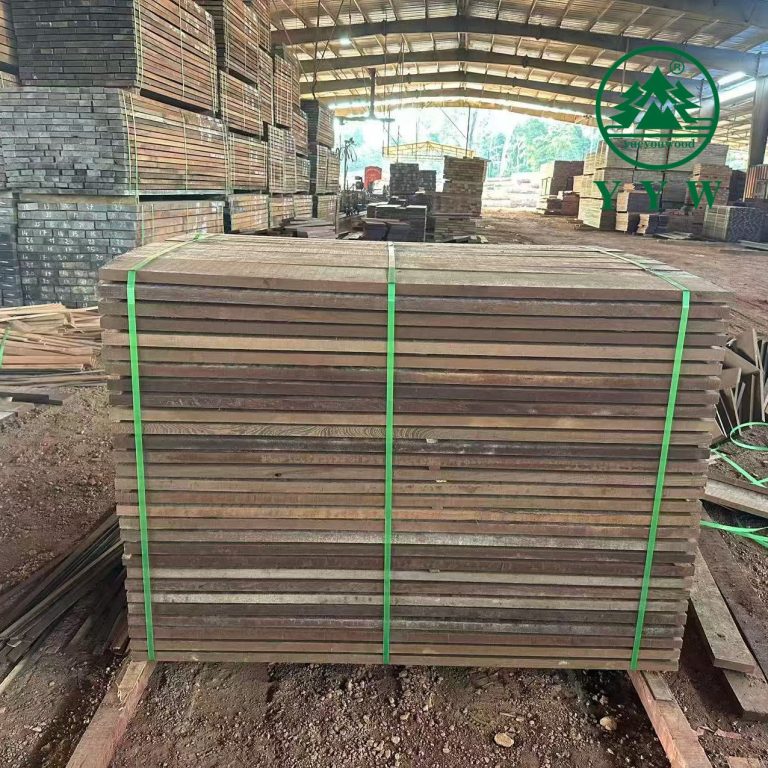
- Use stickers (strapping) to ensure air circulation between layers.
- Maintain consistent ambient conditions (temperature and RH) to avoid re-wetting or over-drying.
- Wrap lumber in breathable plastic if stored outdoors but keep off ground.
- Acclimate timber to the interior environment for at least 48 hours before processing.
Technical Table: Moisture Content Ranges for Common Applications
| Application | Recommended MC (%) | Notes |
|---|---|---|
| Indoor furniture (temperate) | 6–8 | Stable in central heating |
| Kitchen cabinets | 6–9 | May need slightly higher if humid region |
| Hardwood flooring | 6–9 | Acclimate to subfloor conditions |
| Structural framing | 12–16 | Allows for unavoidable movement |
| Decking / outdoor furniture | 12–16 | Pressure-treated to resist decay |
| Musical instruments | 5–7 | Complex shapes require uniform MC |
| Plywood | 8–12 | Depends on core, face veneer |
| Boatbuilding | 8–12 | Must match service environment |
Frequently Asked Questions
Conclusion
Managing timber moisture content is not optional—it’s a prerequisite for quality and longevity. System integrators who understand MC principles, specify correct levels, and enforce checks can reduce callbacks and ensure customer satisfaction. At YYW Timber, we supply kiln-dried African hardwoods with verifiable MC reports. Contact us for a quotation tailored to your project’s required moisture specifications.