Key Takeaways
- Hardwood density directly impacts strength, durability, and machinability, making it a critical factor for system integrators specifying materials for industrial use.
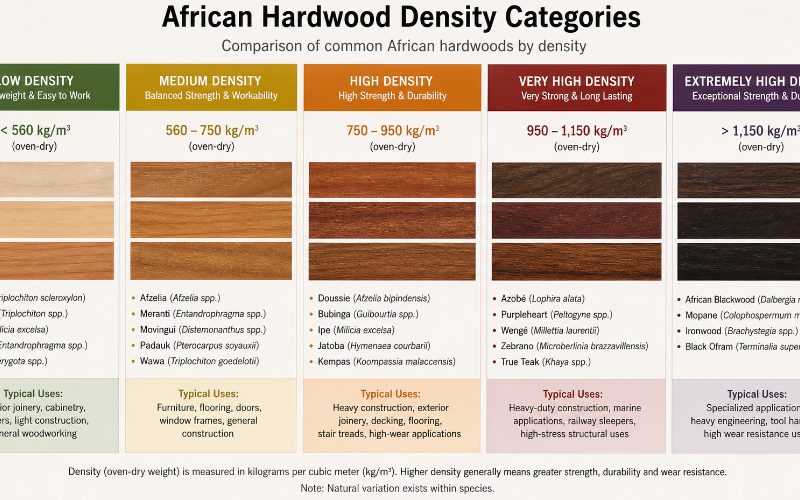
- African hardwoods offer a wide density range (320–1120 kg/m³) allowing selection for specific structural, flooring, or specialty applications.
- Density affects wear resistance, screw holding, and response to moisture — essential for long-term system reliability.
- This chart provides comparative data for key species to support informed procurement.
As a system integrator, selecting the right hardwood for your projects goes beyond aesthetics. Density—a measure of mass per unit volume—is the single most important physical property influencing mechanical performance, durability, and processing characteristics. Whether you are designing load-bearing structures, high-traffic flooring, or precision components, a thorough understanding of hardwood density ensures optimal system performance and long-term value. This comprehensive hardwood density chart and guide focuses on African hardwoods, known for their exceptional density range and engineering properties.
What Is Hardwood Density and Why Does It Matter for System Integrators?
Hardwood density is defined as the mass of wood per unit volume at a specific moisture content, typically measured in kilograms per cubic meter (kg/m³) or pounds per cubic foot (pcf). For system integrators, density is a proxy for several critical performance attributes:
- Strength and Stiffness: Higher density generally correlates with greater compressive, tensile, and bending strength.
- Wear Resistance: Denser woods resist abrasion and indentation, making them ideal for flooring and high-contact surfaces.
- Screw and Nail Holding: Dense timbers provide superior fastener retention, essential for structural assemblies.
- Moisture Stability: While denser woods often have higher shrinkage coefficients, they also exhibit greater dimensional stability when properly dried.
Understanding these relationships allows system integrators to specify materials that meet exact technical requirements, avoiding costly over-engineering or premature failure.
Hardwood Density Chart: Key African Hardwood Species Compared
The following table presents density values (at 12% moisture content), Janka hardness, and typical applications for the most commercially important African hardwoods.
| Species | Density (kg/m³ at 12% MC) | Janka Hardness (N) | Common Industrial Applications |
|---|---|---|---|
| Azobé (Ekki/Bongossi) | 1,050–1,120 | 20,500 | Marine construction, bridge decking, heavy-duty flooring, harbor works, railway sleepers |
| Iroko | 660–690 | 5,700 | Outdoor furniture, doors, windows, boat building, flooring |
| Sapele | 640–690 | 6,700 | Furniture, cabinetry, veneers, musical instruments, doors |
| Khaya (African Mahogany) | 540–610 | 4,700 | Premium furniture, yacht interiors, millwork, doors |
| Okan | 930–1,050 | 16,900 | Marine piling, bridges, heavy timber construction, industrial flooring |
| Doussie (Afzelia) | 800–910 | 8,200 | High-end flooring, stairs, outdoor decking, heavy joinery |
| Padauk (African Padauk) | 700–790 | 7,700 | Luxury furniture, flooring, decorative veneers, musical instruments |
| Tali | 850–950 | 11,000 | Heavy construction, truck flooring, railway sleepers, bridge decking |
| Movingui | 700–780 | 6,900 | Interior joinery, furniture, flooring, veneers |
| Bubinga | 850–950 | 10,900 | Luxury furniture, countertops, veneers, instrument making |
| Wenge | 830–910 | 8,600 | Premium flooring, luxury furniture, decorative panels, stair treads |
| Zebrano (Zebrawood) | 700–790 | 8,100 | Decorative veneers, luxury furniture, cabinetry, automotive interiors |
| Ovangkol | 780–850 | 7,400 | Furniture, flooring, guitar backs and sides, architectural millwork |
| Beli (African Oak) | 720–780 | 6,400 | Flooring, furniture, stair components, interior trim |
| Kosipo | 560–650 | 4,600 | Doors, windows, furniture, plywood, architectural joinery |
| African Teak (Framire/Limba) | 540–620 | 4,300 | Interior furniture, mouldings, plywood, doors, paneling |
| Moabi | 780–850 | 7,800 | Flooring, heavy furniture, exterior joinery, decking |
| Kevazingo | 850–930 | 9,800 | Luxury furniture, veneers, musical instruments, decorative panels |
| Dabema | 720–790 | 7,100 | Flooring, furniture, structural timber, interior joinery |
| Mukulungu | 820–900 | 9,200 | Heavy-duty flooring, decking, bridges, industrial construction |
Notes
- Density values are measured at 12% moisture content (MC), the standard reference for most international timber specifications.
- Janka Hardness measures the resistance of wood to denting and wear; higher values indicate greater hardness.
- Actual density and hardness can vary slightly depending on species origin, growing conditions, moisture content, and grading standards.
- For engineering design, always refer to the supplier’s certified technical data sheet or applicable national/international timber standards.
How Does Density Affect Machinability, Stability, and Longevity in Industrial Use?
Machinability: Dense woods are harder to cut and require sharper tools and slower feed speeds. They produce smoother finishes but generate more heat. For system integrators using CNC machinery, selection must account for tooling cost and processing time.
Stability: Density alone does not guarantee stability. The coefficient of dimensional change varies with species. For example, Iroko (medium density) has excellent stability, while Wenge (high density) is more prone to movement. Proper kiln drying to equilibrium moisture content (6–8% for interior applications) is critical.
Longevity: Higher density woods generally have better natural durability against decay and insect attack. Species like Bubinga and Wenge have high silica content which contributes to wear resistance but also increases tool wear. For industrial components subject to cyclic loading, density influences fatigue life.
How to Interpret Hardwood Density Data in Product Specifications
When reviewing supplier data sheets, pay attention to moisture content at which density is stated. Standard references at 12% MC. Some suppliers may provide green density or air-dry density. For engineering purposes, use oven-dry density or density at equilibrium moisture content. Also consider that density can vary within a species depending on the growing region. For critical applications, request testing certificates.
How to Choose the Right Density Hardwood for Your Project?
Follow these five steps for density-based selection:
- Define mechanical requirements: Determine if strength, stiffness, or wear resistance is most important.
- Assess environmental exposure: Will the wood be used indoors, outdoors, or in wet conditions?
- Evaluate processing capabilities: Do you have equipment for high-density species?
- Consider sustainability and sourcing: Check for CITES restrictions and certification.
- Request sample and test: Always test under your specific conditions.
Frequently Asked Questions
Most industry standards require 6–8% for interior applications and 10–12% for exterior use. Density values are usually given at 12% MC.
Not necessarily. Higher density increases difficulty of machining, weight, and cost. The optimum density depends on the specific application’s demands.
Janka hardness is a measure of resistance to indentation and correlates strongly with density, but it is not identical. For example, some medium-density species can have high hardness due to silica content.
For accurate specifications and traceable sourcing of African hardwoods, contact YYW Timber. We provide detailed technical datasheets for all our products.
Leverage Hardwood Density Data for Better System Integration
Selecting the right hardwood requires more than intuition—it demands accurate data. This hardwood density chart is a starting point, but for your specific project, we recommend consulting with timber experts. At YYW Timber, we offer a wide selection of premium African hardwoods with verified density, hardness, and durability data. Our team supports system integrators with technical guidance, custom cutting, and logistics.