
When purchasing kiln-dried (KD) timber, one of the most important specifications is moisture content.
A supplier may describe timber as kiln-dried, but how can buyers confirm that the moisture content meets their requirements?
For furniture manufacturers, timber importers and woodworking businesses, checking moisture content is an essential part of quality control. Timber with excessive or uneven moisture may cause problems during machining, assembly, storage and installation.
Fortunately, there are several ways to measure wood moisture content, with handheld moisture meters being among the most commonly used tools.
In this guide, YYW Timber explains how to check moisture content in kiln-dried timber, how different moisture meters work and what buyers should consider when inspecting African hardwood before shipment.
1. Why Is Moisture Content Important in Kiln-Dried Timber?
Moisture content directly affects the physical behaviour and dimensional stability of wood.
If timber contains too much moisture, it may continue to shrink as it dries further. On the other hand, timber stored in a humid environment may absorb moisture and expand.
For manufacturers, these changes can lead to several problems:
- Changes in board thickness and width
- Warping and distortion
- Gaps between assembled components
- Problems during machining and finishing
- Cracking or movement after installation
This is why buyers should specify a suitable moisture content before placing an order.
For example, some African hardwood orders specify a KD moisture-content range of 8–12%, depending on the species, application and destination market.
However, this range is not a universal requirement. The appropriate moisture content should be agreed between the buyer and supplier according to the intended use.
2. What Tools Are Used to Measure Timber Moisture Content?
There are several methods for measuring wood moisture content, but handheld moisture meters are widely used in sawmills, timber warehouses and woodworking factories.
Two common types are pin-type and pinless moisture meters.
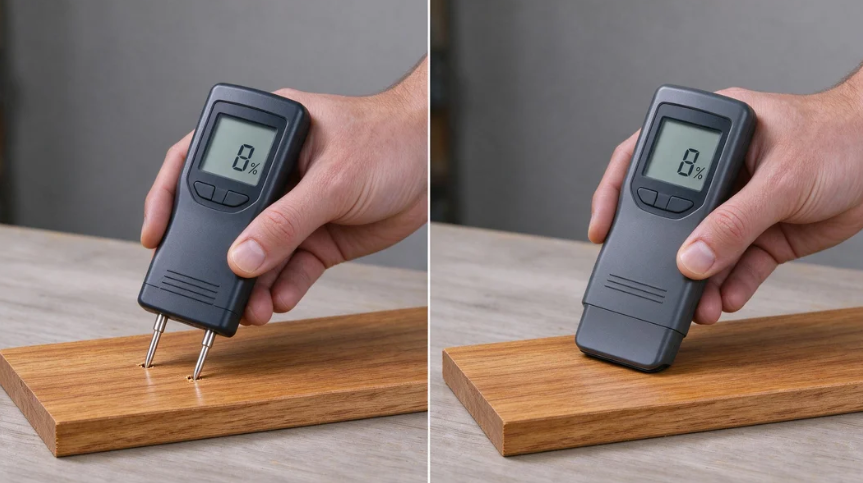
Pin-Type Moisture Meter
A pin-type moisture meter uses two or more metal electrodes that penetrate the timber surface.
The instrument measures the electrical resistance between the electrodes and uses this information to estimate the wood’s moisture content.
Advantages include:
- Suitable for checking individual boards
- Can provide readings at different depths when using suitable insulated electrodes
- Useful for identifying moisture differences between the surface and core
However, pin-type meters leave small holes in the timber. Their readings are also affected by wood temperature and species characteristics.
Pinless Moisture Meter
A pinless moisture meter uses an electromagnetic or dielectric measurement principle to estimate moisture content without penetrating the timber.
The user places the instrument against the wood surface and obtains a reading.
Advantages include:
- Does not leave holes or marks
- Convenient for checking multiple boards
- Useful for rapid surface-area inspections
However, pinless meters generally provide readings over a limited measurement depth and may be influenced by wood density, board thickness and surface conditions.
Neither type of meter is automatically more accurate in every situation. The choice depends on the inspection purpose, timber characteristics and instrument specifications.
3. How to Check Moisture Content Using a Handheld Moisture Meter
For routine timber inspection, buyers and quality-control staff can follow a consistent measurement procedure.
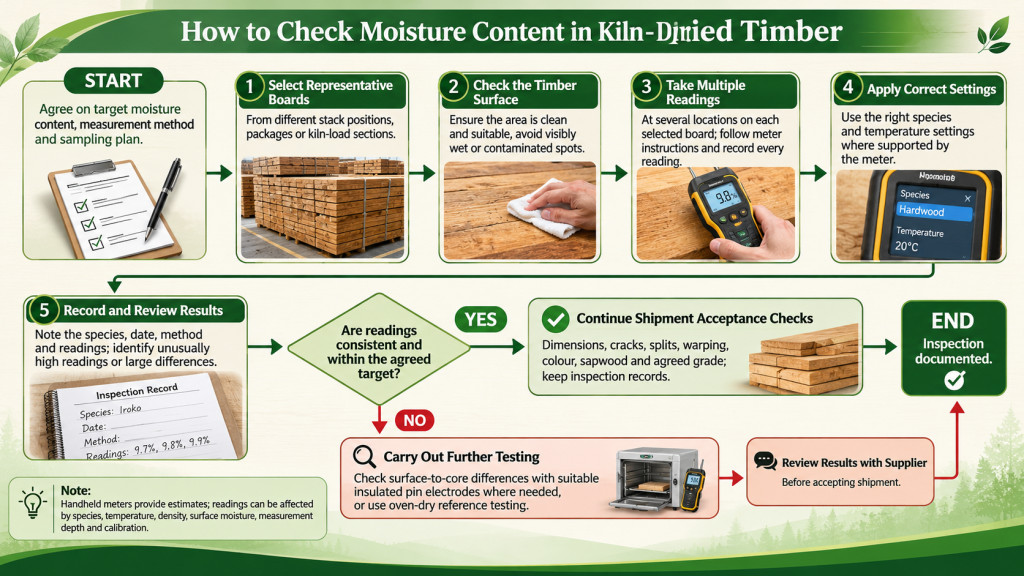
Step 1: Select Representative Boards
Do not measure only one board and assume that the entire shipment has the same moisture content.
Select boards from different positions within the stack, including material from different packages or sections of the kiln load where accessible.
A representative sample gives a more useful picture of the overall timber condition.
Step 2: Check the Timber Surface
Before measuring, make sure the measurement area is clean and suitable for the instrument.
Avoid relying only on visibly wet, dirty or contaminated surfaces. Surface water can affect some readings and may not represent the moisture condition inside the board.
Step 3: Take Multiple Readings
Take readings at several locations on each selected board.
For pin-type meters, follow the manufacturer’s instructions regarding electrode direction and penetration depth.
For pinless meters, make sure the measuring plate has proper contact with the timber surface.
Record the readings instead of relying on a single measurement.
Step 4: Apply Species and Temperature Corrections
Different wood species have different electrical properties and densities.
This means that the same moisture meter setting may not produce equally accurate results for every timber species.
Tropical hardwoods may require specific species corrections because of differences in density and natural extractives.
Wood temperature can also influence resistance-type meter readings.
Where supported, select the correct species and temperature settings according to the meter manufacturer’s instructions.
Step 5: Record and Review the Results
Record the moisture readings, timber species, inspection date and measurement method.
Review the results to identify unusually high readings or significant differences between boards.
If the readings vary considerably, further testing may be necessary before accepting the shipment.
4. Pin-Type vs. Pinless Moisture Meters: Which Is Better?
Both types of moisture meters are useful, but they serve slightly different inspection purposes.
| Comparison | Pin-Type Meter | Pinless Meter |
|---|---|---|
| Measurement method | Electrical resistance | Electromagnetic or dielectric principle |
| Surface damage | Leaves small pin holes | Non-invasive |
| Measurement depth | Depends on electrode length and design | Depends on instrument model |
| Internal moisture assessment | Possible with suitable insulated pins | Limited by sensing depth |
| Inspection speed | Usually slower for multiple readings | Usually faster |
| Important corrections | Species and temperature | Species, density and instrument settings |
For routine incoming inspections, pinless meters offer a convenient way to check multiple boards quickly.
When moisture differences between the surface and core need further investigation, a suitable pin-type meter with insulated electrodes can provide additional information.
If a more accurate reference measurement is required, the oven-dry method is another reliable option.
5. Can a Moisture Meter Give Incorrect Readings?
Yes. Handheld moisture meters are useful inspection tools, but their readings are estimates and can be affected by several factors.
Wood Species
Different species have different electrical characteristics. Incorrect species settings can lead to inaccurate readings.
Wood Temperature
Temperature can affect the electrical resistance of timber. Temperature correction may be necessary, particularly when using resistance-type meters.
Timber Density
Pinless meters can be sensitive to density differences. Using an incorrect density or species setting may affect the result.
Surface Moisture
Rain, condensation or surface water can influence measurements, especially when checking the surface only.
Measurement Depth
A board may have a different moisture content near the surface compared with its centre.
A surface reading alone may therefore fail to identify a wetter core.
Instrument Calibration
Moisture meters should be maintained and checked according to the manufacturer’s recommendations. Poor calibration or damaged electrodes can affect measurement reliability.
Another important point is that many handheld electrical moisture meters are intended mainly for wood below approximately 25–30% moisture content. Their readings become less reliable above this range.

6. What Is the Oven-Dry Method?
The oven-dry method is a reference laboratory procedure for determining wood moisture content.
A timber sample is weighed before drying. It is then placed in a controlled oven until it reaches a constant dry mass.
The moisture content is calculated using the difference between the initial and oven-dry weights.
The standard formula is:
Moisture Content (%) = [(Initial Weight − Oven-Dry Weight) ÷ Oven-Dry Weight] × 100
For example:
| Measurement | Weight |
|---|---|
| Initial sample weight | 110 g |
| Oven-dry weight | 100 g |
| Water lost | 10 g |
| Moisture content | 10% |
The moisture content is calculated as:
(110 − 100) ÷ 100 × 100 = 10%
Unlike a quick handheld reading, oven-dry testing provides a reference measurement based on the actual mass of water removed from the sample.
However, it is destructive because the sample must be dried in an oven. It also requires suitable equipment and a controlled testing procedure.
For routine factory inspections, handheld meters are generally more convenient. Oven-dry testing can be used when a more formal reference result is required.
7. What Should Buyers Check Before Accepting a KD Timber Shipment?
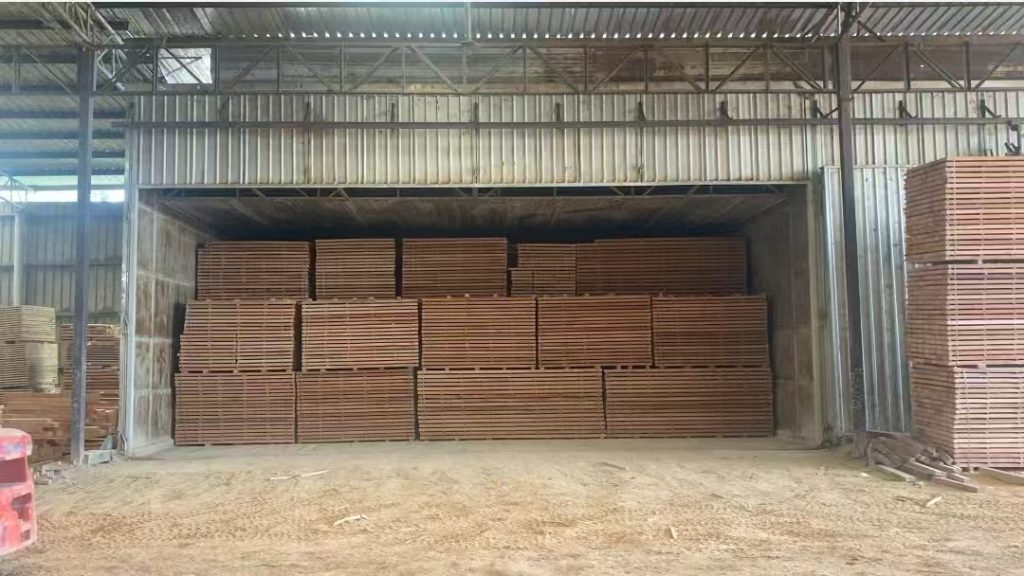
When purchasing kiln-dried African hardwood, buyers should establish clear inspection requirements before shipment.
Here are several important points to consider:
1. Agree on the Target Moisture Content
Specify the required moisture-content range in the purchase contract or order confirmation.
For example, if your production requires 8–12% MC, make sure the supplier understands whether this refers to the average reading, an acceptable range for individual boards or a maximum limit.
2. Agree on the Measurement Method
Discuss whether moisture content will be checked using a handheld meter, an oven-dry method or another agreed procedure.
3. Establish a Sampling Plan
Agree on how many boards will be tested and where samples will be taken from.
Testing only a few conveniently accessible boards may not represent the entire shipment.
4. Check More Than the Surface
Where necessary, use suitable equipment to assess moisture differences between the surface and core.
5. Inspect Overall Timber Quality
Moisture content is only one part of timber quality.
Buyers should also inspect dimensions, cracks, splits, warping, colour, sapwood proportion and other agreed grading requirements.
6. Keep Inspection Records
A clear inspection report should include the species, moisture readings, measurement method, sampling details and inspection date.
This provides useful documentation for both the supplier and buyer.
8. Moisture Content Inspection at YYW Timber
At YYW Timber, we understand that moisture content is an important consideration when supplying kiln-dried African hardwood.
Different species and timber thicknesses require appropriate drying and inspection arrangements. Buyers may also have different moisture requirements depending on their production processes and destination markets.
Whether you are sourcing KD Okoume, Iroko, Sapelli, Tiama or other African hardwoods, we welcome discussions about your required moisture content, timber dimensions and quality specifications.
Our team works with buyers to understand their requirements and discuss suitable supply arrangements.
Looking for kiln-dried African hardwood with specific moisture requirements?
Contact YYW Timber to discuss your order specifications and quality expectations.
Website: www.yywtimber.com