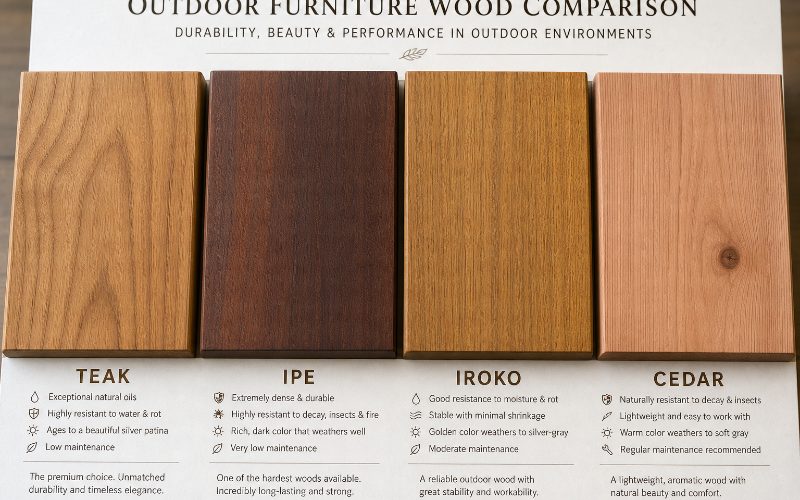
BLUF (Bottom Line Up Front): For B2B buyers, the best wood for outdoor furniture balances durability, workability, cost, and sustainability. Teak and Ipe lead in performance but Iroko and Accoya offer cost-effective alternatives with proper treatment. Always prioritize dense, naturally rot-resistant species and verify certifications.
Key Takeaways
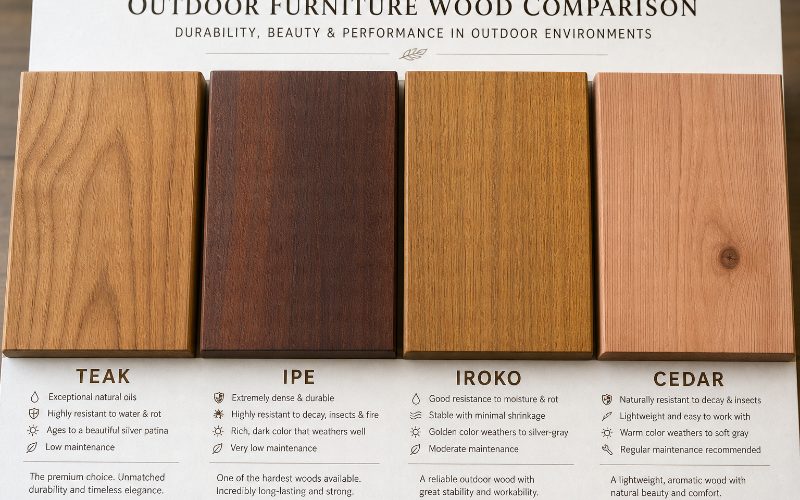
- Teak and Ipe remain the gold standard for outdoor durability, offering natural oils and high density.
- African hardwoods like Iroko provide cost-effective alternatives with comparable rot resistance.
- Proper drying (kiln-dried to 8-12% MC) and finishing (UV-protective oil) are essential for longevity.
- Certifications (FSC, SGS) ensure sustainability and compliance with international regulations.
- Sourcing from reputable suppliers with consistent grading and dimension accuracy reduces waste.
Why Wood Choice Matters for Outdoor Furniture
As a B2B buyer, selecting the right wood for outdoor furniture directly impacts product lifespan, maintenance costs, and brand reputation. Improper wood selection leads to warping, cracking, and decay, resulting in warranty claims. This technical guide provides data-driven comparisons and sourcing insights for system integrators, distributors, and manufacturers.
What Are the Key Properties of Outdoor Furniture Wood?
Several physical and mechanical properties determine a wood species’ suitability for outdoor use:
- Density & Janka Hardness: Higher density (>600 kg/m³) resists dents and wear. Janka hardness above 800 lbf is recommended for commercial outdoor seating.
- Rot Resistance: Natural extractives (e.g., tectoquinone in teak) inhibit fungal decay. Class 1 (durable) or Class 2 (moderately durable) per EN 350 is ideal.
- Dimensional Stability: Low shrinkage coefficients prevent warping with humidity changes. Quarter-sawn lumber offers better stability.
- Workability: Species that machine cleanly without excessive tool wear reduce fabrication costs.
- Maintenance: Oily woods require less frequent finishing. UV resistance reduces color fading.
- Sustainability & Cost: FSC-certified options meeting green building standards (LEED, BREEAM) command premium pricing but satisfy procurement policies.
How Do Teak and Ipe Compare for Outdoor Furniture?
Teak (Tectona grandis) and Ipe (Handroanthus spp.) are benchmark species for outdoor furniture. Below is a technical comparison with two alternatives: Iroko and Thermally Modified Ash.
| Property | Teak | Ipe | Iroko | Thermally Modified Ash |
|---|---|---|---|---|
| Botanical Name | Tectona grandis | Handroanthus spp. | Milicia excelsa | Fraxinus spp. (modified) |
| Janka Hardness (lbf) | 1,155 | 3,680 | 1,260 | 1,300 (after TM) |
| Density (kg/m³) | 650 | 1,050 | 660 | 650 |
| Rot Resistance (EN 350) | Class 1 (very durable) | Class 1 (very durable) | Class 2 (durable) | Class 2 (durable) |
| Workability | Excellent | Moderate (hard on tools) | Good | Good |
| Moisture Content (as shipped) | 8–10% (KD) | 8–10% (KD) | 10–12% (KD) | 6–8% (TM) |
| Price Index (1–10) | 8 | 9 | 5 | 6 |
| Typical Lifespan (unfinished) | 25–40 years | 40–50 years | 15–25 years | 20–30 years |
| Sustainability (FSC available) | Yes (plantation) | Limited (natural forest) | Yes (certified) | Yes (plantation) |
Teak: The Premium Standard
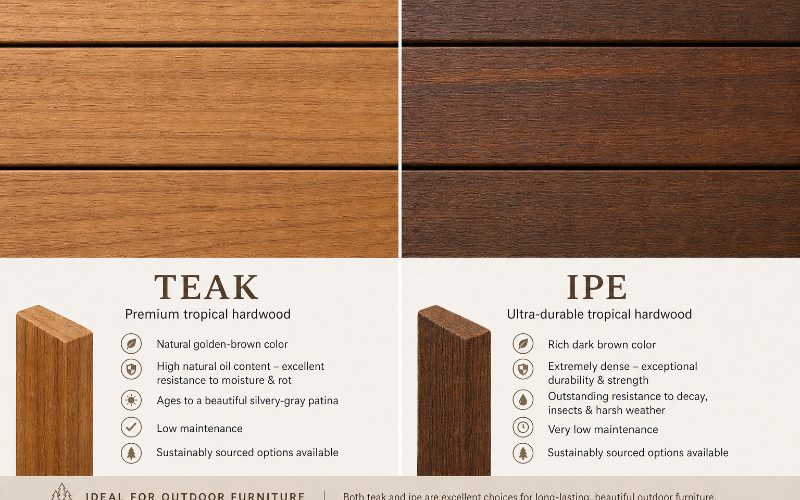
Teak contains natural oils (tectoquinone) that repel termites and fungi. Its moderate density (650 kg/m³) makes it easy to machine, yet durable enough for high-end outdoor furniture. Kiln-dried teak (8–10% MC) from plantations maintains dimensional stability. The primary downside is cost; plantation teak prices range from $3,000–$5,000/m³ FOB.
Ipe: High Density, Extreme Longevity
Ipe is one of the densest commercial hardwoods (1,050 kg/m³) with a Janka hardness exceeding 3,600 lbf. Its natural resistance to rot and insects surpasses even teak. However, high density requires carbide tooling and pre-drilling fasteners. Ipe is sourced primarily from natural forests in Brazil; FSC certification is limited but available. It offers the longest lifespan (40–50 years) but at a high cost ($5,000–$8,000/m³).
What Are the Best African Hardwoods for Outdoor Furniture?
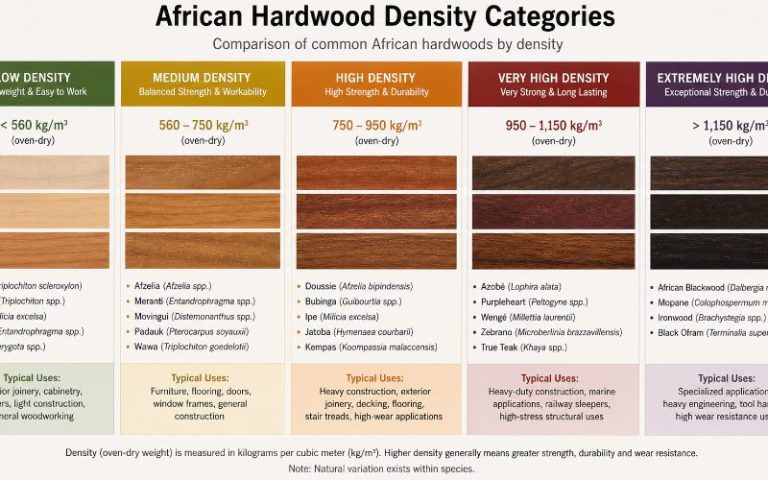
African hardwoods offer a balance of performance and value. Species commonly used in outdoor furniture include:
- Iroko (Milicia excelsa): Often called “African teak,” Iroko has a Janka of 1,260 lbf and natural oils that resist decay. It machines well and accepts finishes. Class 2 durability gives 15–25 years outdoors. Price: $800–$1,200/m³.
- Sapele (Entandrophragma cylindricum): Janka 1,510 lbf, density 640 kg/m³. Good rot resistance but less than Iroko. Often used for outdoor furniture with protective finishes. Price: $1,200–$1,800/m³.
- Afzelia (Afzelia africana): Janka 1,700 lbf, high durability. Used for decking and heavy outdoor furniture. Price: $1,500–$2,000/m³.
- Utile (Entandrophragma utile): Similar to Sapele, moderate durability, good workability. Price: $1,000–$1,500/m³.
How Does Wood Treatment and Maintenance Affect Longevity?
Even durable woods benefit from proper treatment:
- Kiln-drying to 8–12% MC reduces internal stresses and minimizes warping.
- Surface finishing with UV-blocking oils or sealers prevents graying and cracking. Teak requires annual oiling; Ipe needs a penetrating sealer.
- End-grain caps and stainless steel fasteners prevent moisture ingress and corrosion.
- Periodic cleaning with mild biocide removes mildew.
What Certifications Should Buyers Look For?
Regulatory compliance and sustainability are critical for B2B procurement:
- FSC (Forest Stewardship Council): Ensures sustainable forest management. Required for LEED and BREEAM projects.
- SGS / TUV: Third-party verification of grading and moisture content.
- EU Timber Regulation (EUTR): Due diligence to prevent illegal logging.
- LS (LegalSource): Chain-of-custody certification for legal sourcing.
Always request the exporting supplier’s Certificate of Origin and Phytosanitary Certificate to avoid trade complications.
How to Source High-Quality Timber for Outdoor Furniture
Follow these steps to ensure consistent supply:
- Specify grading rules: NHLA or custom specifications (clear, select, common).
- Require kiln-dried lumber: 8–12% MC for most species.
- Request moisture content testing certificates from an independent lab.
- Negotiate dimension tolerances: ±1mm for precision.
- Verify volume and packaging: Fumigated crates (ISPM 15) for export.
- Establish a quality checklist: Check for cracks, sapwood, and insect holes.
Frequently Asked Questions
Yes, for high-end commercial projects. Teak’s natural oils, dimensional stability, and 25–40 year lifespan without finish justify the $3,000–$5,000/m³ cost. For budget-sensitive orders, consider Iroko or thermally modified ash.
Iroko offers 80% of teak’s performance at 25% of the cost. It has similar density (660 kg/m³) and Class 2 rot resistance. However, it lacks teak’s natural oil content and may need more frequent sealing. Lifespan is 15–25 years vs. 25–40 for teak.
Both are dense South American hardwoods. Cumaru (Dipteryx odorata) has a Janka of 3,330 lbf (slightly less than Ipe) and similar durability. Cumaru is often more expensive and has a slightly oilier feel. Both are excellent for outdoor furniture but require carbide tooling.
Sealing is recommended even for durable species. Unfinished wood will weather to a silver-gray patina but may develop micro-cracks. A UV-protective oil (e.g., tung or teak oil) applied annually extends surface life. For high-traffic commercial settings, use a marine-grade finish.
Teak and Ipe are top choices due to their natural resistance to rot and insects. For lower budget, thermally modified ash or long-leaf pine (treated) can work with proper finish. Avoid species like oak or maple which are not naturally durable.
Next Steps for B2B Buyers
Choosing the right wood for outdoor furniture requires balancing technical properties, cost, and sustainability. When sourcing, request technical data sheets, moisture content reports, and chain-of-custody certifications. To discuss your specific requirements or request a quotation for African hardwoods, contact our team.
YYW Timber is a trusted supplier of African hardwoods, offering FSC-certified, kiln-dried lumber for outdoor furniture manufacturers worldwide.